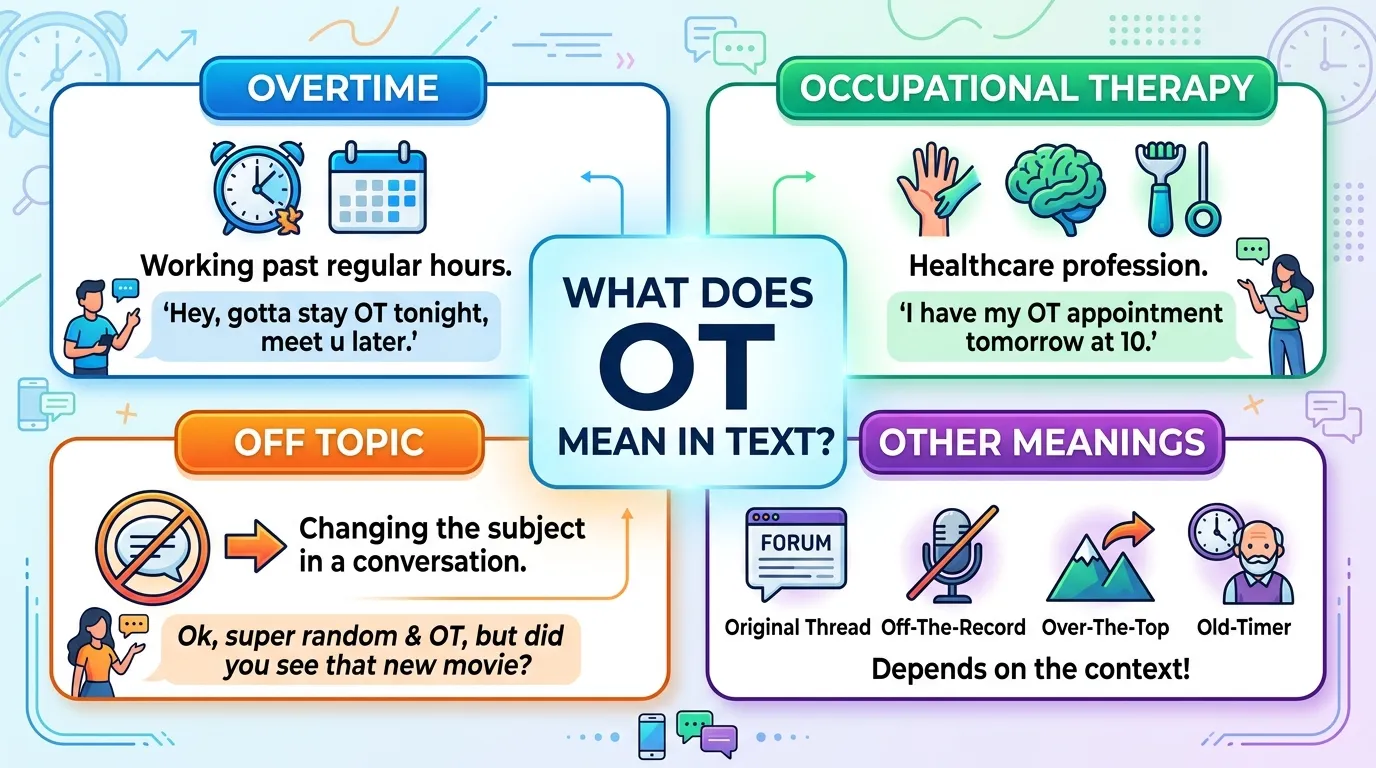
If you came across OT in a text or social media post and weren’t sure what it meant, you are not alone. OT most commonly stands for “Off Topic” in text messages and online conversations. People use it when a discussion or comment has moved away from the original subject being talked about.
Understanding what does OT mean in text is helpful because this abbreviation shows up regularly on Twitter/X threads, Reddit discussions, WhatsApp group chats, Instagram comments, and everyday text conversations. It is a quick and polite way to point out that something is drifting away from the main point of a conversation.
People search for OT because it is short and carries more than one meaning depending on the context. OT can also stand for “Overtime” in sports and work conversations, or “On Topic” in certain online communities.
Knowing which meaning applies always comes down to reading the situation carefully. This guide covers every meaning of OT clearly with real examples so you never feel confused again when you see it in any conversation.
OT Meaning in Text
The most common meaning of OT in texting is “Off Topic.” It lets others know that a message isn’t directly related to the current discussion.
For example, imagine a group chat about planning a birthday party. If someone suddenly asks about a football game, another person might reply, “OT, but did anyone watch the match last night?” This tells everyone the conversation is briefly changing direction.
Is OT an Acronym or Slang?
OT is an abbreviation and an internet acronym. While it isn’t traditional slang like “lit” or “sus,” it has become part of everyday online language.
People use it because it’s short, easy to type, and widely recognized across messaging apps and social media.
What Does OT Mean in Everyday Chat?
In normal conversations, OT usually has one of these meanings:
- Off Topic (most common in chats and forums)
- Overtime (used when discussing work or sports)
- Occupational Therapy (used in healthcare conversations)
Because OT has several meanings, always read the surrounding messages before deciding what it means.
Examples of OT Meaning
- OT, but your new profile picture looks amazing!
- Sorry for going OT, let’s get back to the meeting.
- I’m working OT this weekend to finish the project.
- My doctor recommended OT after the injury.
As you can see, the meaning changes depending on the conversation.
Different Meanings of OT
Although Off Topic is the most popular definition in online conversations, it’s not the only one.
OT = Off Topic
This is the version you’ll see most often on Reddit, Discord, Facebook groups, forums, and group chats.
Example:
OT, but where did you buy those shoes?
The speaker knows the question isn’t related to the current discussion.
OT = Overtime
At work, OT usually refers to overtime hours.
Example:
I had to work OT yesterday.
Here, the person means they worked extra hours beyond their regular schedule.
OT = Occupational Therapy
In medical settings, OT stands for Occupational Therapy.
Example:
My child starts OT next Monday.
Healthcare professionals commonly use this abbreviation.
Other Less Common Meanings
Depending on the industry or community, OT can occasionally mean:
- Old Testament
- On Topic
- Operational Test
- Other Terms used within specific organizations
However, these meanings are much less common in everyday texting.
Where People Use OT
You’ll find OT across many social media platforms and messaging apps. While the meaning stays similar, the way people use it can vary slightly depending on the platform.
OT on TikTok
On TikTok, users often write OT in comments when they want to mention something unrelated to the video.
Example:
OT, your outfit is incredible!
Instead of talking about the video’s topic, they’re complimenting the creator.
OT on Snapchat
Snapchat conversations are usually casual and fast. Friends often use OT before changing the subject.
Example:
OT, are we still meeting tonight?
This lets the other person know they’re switching topics.
OT on Instagram
You’ll often notice OT in Instagram comments, direct messages, and story replies.
Someone may write:
OT, where did you get that jacket?
Even though the post isn’t about clothing, they’re asking a separate question.
OT on WhatsApp
Family chats, school groups, and work groups frequently use OT to keep conversations organized.
For example:
OT: Does anyone know when the holiday starts?
This signals that the message isn’t connected to the current discussion.
OT in SMS Text Messages
Traditional text messaging also uses OT, although it’s less common than on social media.
Friends may use it simply because typing two letters is quicker than writing “Off Topic.”
Real Chat Examples
Here are realistic conversations showing how people use OT naturally.
Example 1
A: Did you finish the history assignment?
B: Almost.
A: OT, are you coming to football practice later?
Example 2
A: Everyone bring snacks tomorrow.
B: Sure.
A: OT, who’s driving?
Example 3
A: That movie was amazing.
B: I loved it too.
A: OT, have you watched the new series yet?
Example 4
A: The meeting starts at 9.
B: Thanks.
A: OT, don’t forget your laptop.
Example 5
A: We need to finish this project today.
B: I’m almost done.
A: I may have to work OT tonight.
Example 6
A: How’s your shoulder?
B: It’s getting better.
A: My doctor suggested OT after my surgery.
Example 7
A: Nice photo!
B: Thank you.
A: OT, where did you buy your camera?
Example 8
A: Are we still playing tonight?
B: Yes.
A: OT, have you eaten dinner yet?
Example 9
A: I’ll send the report soon.
B: Great.
A: Sorry for going OT, but did you see today’s news?
Example 10
A: The exam was difficult.
B: Definitely.
A: OT, when does our next class start?
How to Reply When Someone Says “OT”
If someone uses OT in a conversation, your reply depends on what they mean. Most of the time, they’re simply letting you know they’re changing the subject. You don’t need to respond in any special way—just answer their new question or comment naturally.
Here are some examples of replies you can use.
Funny Replies
A little humor can keep the conversation light.
- “Haha, I’ll allow the OT this time!”
- “Changing topics already? That was quick!”
- “You really took a detour there!”
- “OT approved. Go ahead!”
- “We’re officially off the rails now.”
These replies work best when chatting with friends or family.
Casual Replies
Casual responses are perfect for everyday texting.
- “Sure, what’s up?”
- “No problem.”
- “Go ahead.”
- “That’s okay.”
- “I don’t mind.”
They’re simple, friendly, and fit almost any conversation.
Friendly Replies
If you want to sound warm and welcoming, try one of these.
- “Of course! What did you want to ask?”
- “That’s totally fine.”
- “Happy to chat about it.”
- “No worries at all.”
- “I’m listening.”
These replies help keep the conversation comfortable.
Neutral Replies
For work chats, school discussions, or professional conversations, a neutral response is often the best choice.
- “That’s fine.”
- “Please continue.”
- “Thanks for letting us know.”
- “Let’s discuss it.”
- “We can come back to the main topic afterward.”
Professional replies help maintain a respectful tone while allowing the conversation to continue.
Is OT Rude or Offensive?
No. OT is not considered rude or offensive.
It’s simply a shorthand way of saying that someone is moving away from the current topic. Most people use it politely to avoid interrupting a discussion without warning.
For example, if everyone is discussing homework in a group chat and you suddenly need to ask about tomorrow’s football game, you might write:
OT, does anyone know what time practice starts?
This lets everyone know you’re asking something unrelated instead of unexpectedly changing the conversation.
Is It Safe to Use?
Yes.
OT is generally safe for:
- Text messages
- WhatsApp chats
- Snapchat
- Instagram messages
- Discord
- Online communities
- Group conversations
Most internet users understand what it means.
Is It Appropriate at School or Work?
Usually, yes.
In workplace chats or school discussions, using OT can actually be helpful because it tells everyone you’re changing subjects.
However, if you’re writing a formal email, report, or business document, it’s better to write “off topic” instead of using the abbreviation.
For example:
Better in an email:
This may be slightly off topic, but I have a quick question.
This sounds more professional than simply writing OT.
Who Uses This Term?
OT has been around for many years and is used by people of different ages.
Although younger internet users often rely on abbreviations, adults also use OT, especially in online forums, workplace chats, and community discussions.
Teenagers and Gen Z
Gen Z commonly uses abbreviations to type faster.
You’ll see OT in:
- TikTok comments
- Snapchat conversations
- Discord servers
- Gaming chats
- Instagram DMs
For younger users, abbreviations help keep conversations quick and informal.
Millennials
Many Millennials also use OT, particularly in:
- Facebook groups
- Reddit communities
- WhatsApp chats
- Slack conversations
They often use it when changing the subject during online discussions.
Adults and Professionals
In workplace messaging apps like Microsoft Teams, Slack, or Google Chat, employees sometimes use OT before asking an unrelated question.
For example:
OT: Has anyone booked the meeting room for tomorrow?
This helps avoid confusing other team members.
How Common Is OT Online?
While OT isn’t as common as abbreviations like LOL, IDK, or BRB, it still appears regularly across social media, discussion forums, and messaging apps.
Its popularity comes from how useful it is for organizing conversations.
Origin of the Term
Unlike many internet slang words that started on TikTok or Twitter, OT is much older.
Early Internet Communities
The abbreviation OT became popular during the early days of internet discussion boards and online forums.
People often discussed one main subject in each thread. Whenever someone wanted to ask something unrelated, they would begin with:
OT
This immediately told readers that the next message wasn’t connected to the original topic.
Over time, this simple abbreviation became a standard part of online communication.
Growth Through Internet Culture
As internet forums evolved into social media platforms, users brought many old abbreviations with them.
That’s why OT eventually appeared on:
- Discord
- Snapchat
Even today, many online communities still use it exactly the same way.
Is the Origin Certain?
Yes, the most widely accepted origin is that OT developed as a shortcut for “Off Topic” in early internet forums and message boards.
However, because OT also means Overtime and Occupational Therapy, the exact meaning always depends on the conversation.
Comparison Table
| Term | Meaning | Type | Usage | Popularity |
| OT | Off Topic (most commonly) | Abbreviation | Changing the subject in a conversation | Medium |
| IDK | I Don’t Know | Acronym | Expressing uncertainty | Very High |
| IDC | I Don’t Care | Acronym | Showing a lack of interest or concern | High |
| IMO | In My Opinion | Acronym | Sharing a personal opinion | High |
| BRB | Be Right Back | Acronym | Letting someone know you’ll return soon | Very High |
Compared to these abbreviations, OT is more situational. People mainly use it when they want to move away from the current topic without confusing others.
Real-World Usage Example
Imagine you’re in a class group chat discussing tomorrow’s science project. Everyone is sharing ideas about the assignment.
Suddenly, you remember that the football practice schedule has changed. Instead of interrupting the discussion without warning, you send a message like this:
OT: Does anyone know if football practice is still at 5 PM today?
Everyone immediately understands that your question isn’t related to the science project. Once someone answers, the group can easily return to the original discussion.
This is one of the most common ways people use OT in everyday conversations.
FAQs:
What does OT mean in text messages?
In most text messages, OT means “Off Topic.” It tells others that the next message is about a different subject. In some conversations, it can also mean Overtime or Occupational Therapy, depending on the context.
What does OT mean on TikTok?
On TikTok, OT usually means “Off Topic.” Users often include it in comments when they want to mention something unrelated to the video.
Is OT slang?
Not exactly. OT is better described as an internet abbreviation or acronym rather than traditional slang. It’s commonly used in online conversations to save time while typing.
Is OT rude or offensive?
No. OT is not rude or offensive. It’s a polite way to let others know you’re changing the subject in a conversation.
How should you reply to OT?
A simple reply like “Sure,” “Go ahead,” “No problem,” or “What’s up?” works well. Just respond naturally based on the new topic the other person introduces.
Conclusion:
The abbreviation OT most commonly means “Off Topic” in text messages and online conversations. It’s a simple way to let others know you’re switching to a different subject without causing confusion.
You’ll see OT on platforms like TikTok, Snapchat, Instagram, WhatsApp, Reddit, Discord, and in everyday texting. Depending on the context, it can also stand for Overtime or Occupational Therapy, so it’s always important to read the surrounding conversation before deciding what it means.
Overall, OT is friendly, widely understood, and safe to use in casual conversations. In formal emails or professional documents, it’s usually better to write “off topic” instead of using the abbreviation.

Sarah Whitfield is a Bible researcher and writer at askmeanings.com She explains biblical meanings in a simple and easy-to-understand way.