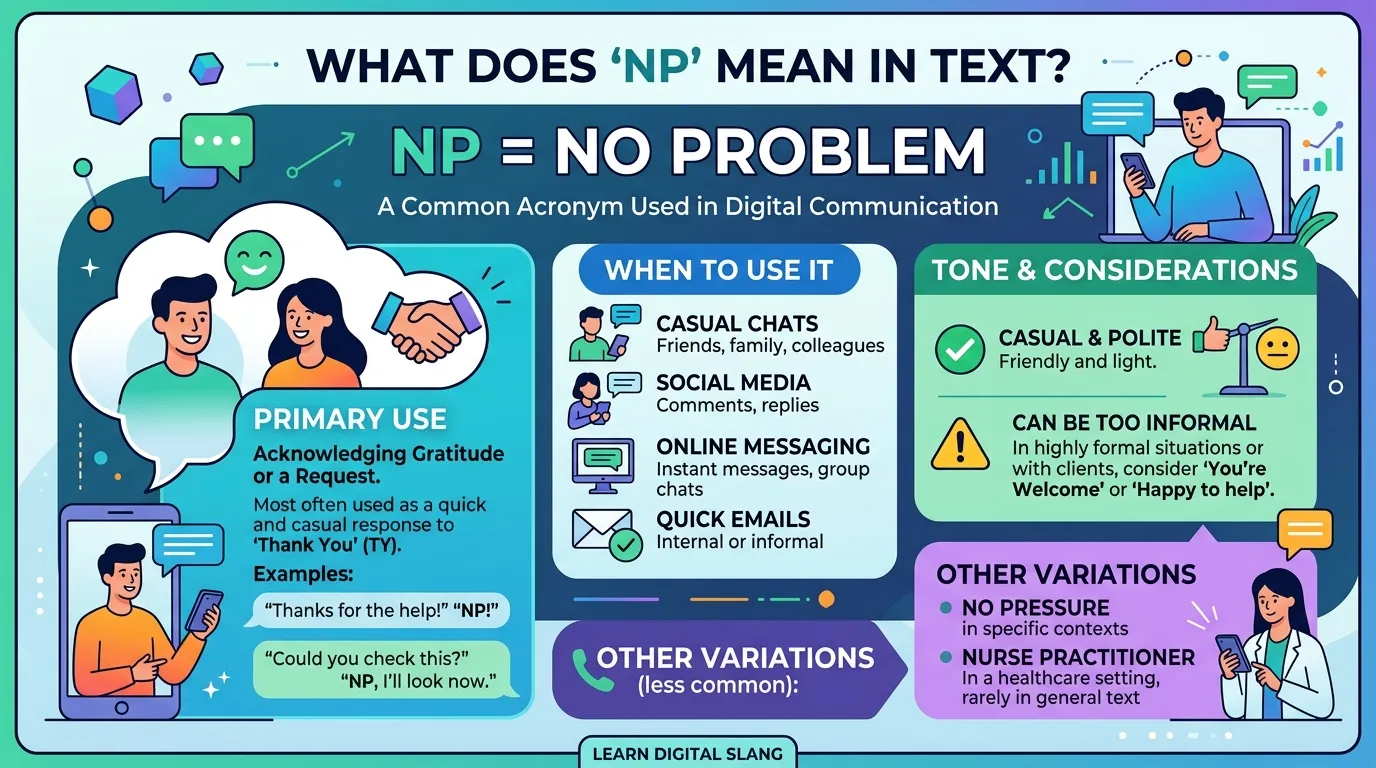
Have you ever received a message with NP and wondered what it actually means? You are not alone. Millions of people search what does NP mean in text every single day. NP is one of the most commonly used short forms in online chats social media platforms and everyday digital conversations.
NP simply stands for “No Problem.” It is a quick, friendly way to say you are okay with something or that no thanks is needed. People use NP in text messages, WhatsApp, Instagram DMs, Twitter replies, and even professional emails.
This short abbreviation saves time and keeps conversations smooth and natural. Whether someone thanks you or apologizes, replying with NP feels casual and polite at the same time.
In this complete guide, you will learn the real meaning of NP in text, see real-life examples and understand exactly how and when to use it correctly across different platforms.
NP Meaning in Text
The abbreviation NP most commonly means “No Problem.” It’s a polite and casual response people use after someone says “thank you.” Instead of typing the full phrase, many people simply write NP because it’s faster and easier.
For example, imagine your friend thanking you for sending today’s homework. Rather than replying with a long message, you can simply respond with NP, letting them know you were happy to help.
In everyday conversations, NP carries a positive tone. It tells the other person that helping them wasn’t difficult and that there’s no need for them to worry or feel guilty. Because of this, it’s one of the friendliest abbreviations you’ll come across in texting.
Unlike some internet slang that can have several meanings depending on the situation, NP is usually very straightforward. In almost every casual conversation, it simply means No Problem.
Is NP an Acronym, Abbreviation, or Slang?
NP is generally considered an abbreviation or initialism because it is formed using the first letter of each word in the phrase No Problem.
Many people also refer to it as internet slang because it’s commonly used in online chats and social media. However, unlike expressions such as “GOAT” or “Rizz,” NP isn’t trendy slang with a hidden meaning. It’s simply a shortened version of a common everyday phrase.
Since it has been around for many years, NP is recognized by people of different age groups and is understood almost everywhere online.
What Does NP Mean in Everyday Conversations?
In daily conversations, NP is used to reassure someone after they’ve thanked you or apologized.
For instance, if someone says:
“Thanks for helping me with my assignment.”
You might simply reply:
“NP!”
That short reply communicates the same idea as saying:
- You’re welcome.
- No worries.
- Happy to help.
- It was nothing.
- Anytime.
This is why NP has remained popular for so long. It saves time while still sounding friendly and polite.
Why Do People Use NP Instead of “You’re Welcome”?
Texting is all about speed and convenience. Many people prefer typing just two letters instead of writing an entire sentence.
Using NP also makes conversations feel more relaxed. Instead of sounding formal, it creates a casual and friendly atmosphere, especially when chatting with friends, classmates, or family members.
Here are a few common situations where people use NP:
- After someone thanks them.
- After helping a friend.
- When sharing information.
- After answering a question.
- When reassuring someone who apologizes.
- During casual online conversations.
Because it’s short and universally understood, NP has become one of the most frequently used abbreviations in digital communication.
Different Ways People Express the Same Meaning
Although NP is very common, people often use other phrases with the same meaning. Depending on the conversation, you might also see:
- No worries
- You’re welcome
- Anytime
- Happy to help
- My pleasure
- Don’t mention it
- It was nothing
All of these expressions communicate a similar idea, but NP is usually the quickest option when texting.
Does NP Ever Mean Something Else?
In casual texting, NP almost always means “No Problem.”
However, in specialized fields such as mathematics, science, gaming, or business, the abbreviation NP can represent completely different terms. For example, in computer science, NP refers to a class of computational problems, while in healthcare it may stand for “Nurse Practitioner.”
The meaning depends on the context. If you’re chatting with friends on Snapchat, TikTok, Instagram, WhatsApp, or through text messages, you can safely assume that NP means No Problem.
Where People Use NP
NP appears across almost every messaging platform because it’s quick to type and easy to understand. Whether you’re chatting privately with a friend or replying to a comment on social media, you’ll likely come across this abbreviation.
Here’s how people commonly use it on different platforms.
NP on TikTok
TikTok users frequently use NP in comments and direct messages.
Someone might ask a question about a video, receive an answer, and reply:
“Thanks!”
The creator or another user may simply respond:
“NP!”
It’s a fast and friendly way of acknowledging appreciation without writing a longer response.
You’ll also see NP in conversations between followers discussing trends, challenges, recipes, study tips, or product recommendations.
NP on Snapchat
Snapchat is known for quick, informal conversations, making NP a perfect fit.
Friends often use it after sending a Snap, helping with homework, sharing information, or answering questions.
For example:
Friend 1: Thanks for reminding me about the meeting.
Friend 2: NP!
Since Snapchat conversations are usually brief, abbreviations like NP help keep chats fast and natural.
NP on Instagram
Instagram users commonly write NP in direct messages, story replies, and comment sections.
Suppose someone asks where you bought a particular product. After you answer, they may thank you.
A simple reply like:
“NP!”
feels warm, polite, and conversational.
Influencers and content creators also use NP when interacting with followers because it’s friendly without sounding overly formal.
NP on WhatsApp
WhatsApp is one of the most popular messaging apps in the world, and NP appears regularly in personal chats, family groups, and school or work conversations.
Imagine a coworker thanking you for sending an important document. Instead of typing a full sentence, you can simply reply:
“NP.”
The message is short, clear, and easy to understand.
Family members and close friends also use NP daily because it keeps conversations moving without unnecessary typing.
NP in SMS (Text Messages)
Even though many people now use messaging apps, traditional SMS texting remains popular.
NP has been part of text messaging for decades and continues to be one of the most recognized abbreviations.
Whether someone thanks you for directions, a reminder, or a favor, replying with NP lets them know you were happy to help.
Because it’s simple, polite, and widely understood, it works well in almost every casual text conversation.
Why NP Is So Popular Across Social Media
One reason NP has remained popular for so many years is its simplicity. Unlike newer slang that changes with trends, NP has a clear meaning that almost everyone understands.
It’s short enough to type in seconds, friendly enough for everyday conversations, and versatile enough to work across nearly every social platform.
Whether you’re chatting on TikTok, Snapchat, Instagram, WhatsApp, Discord, Facebook Messenger, or through regular text messages, NP continues to be one of the easiest and most useful abbreviations to know.
Real Chat Examples
One of the easiest ways to understand NP is by seeing how people actually use it in conversations. The examples below are based on everyday texting situations you might have with friends, classmates, family members, or coworkers.
Example 1
A: Thanks for sending me the class notes.
B: NP! Hope they help.
A: They definitely will. Thanks again!
Example 2
A: Sorry for texting you so late.
B: NP, I was still awake.
A: Glad I didn’t disturb you.
Example 3
A: Thanks for explaining that TikTok trend.
B: NP! It can be confusing at first.
A: Now it finally makes sense.
Example 4
A: Can you send me the meeting link?
B: Sure, just send it.
A: Got it. Thanks!
B: NP.
Example 5
A: I really appreciate your help today.
B: NP! Happy to help anytime.
A: You’re awesome.
Example 6
A: Thanks for picking me up after school.
B: NP.
A: See you tomorrow!
Example 7
A: Sorry I couldn’t reply earlier.
B: NP. I wasn’t in a hurry.
A: Thanks for understanding.
Example 8
A: Thanks for recommending that movie.
B: NP! Did you enjoy it?
A: It was amazing.
Example 9
A: Thanks for helping me finish the project.
B: NP. Teamwork makes everything easier.
A: Absolutely!
Example 10
A: Appreciate your quick response.
B: NP!
A: Have a great day.
How to Reply When Someone Says “NP”
When someone replies with NP, they’re simply letting you know that helping you wasn’t a problem. In many cases, you don’t even need to respond because the conversation naturally comes to an end.
However, if you’d like to keep the conversation going or show extra appreciation, there are plenty of natural ways to reply.
Funny Replies
If you’re chatting with close friends, a little humor can make the conversation more enjoyable.
Here are a few playful responses:
- You’re officially my favorite person.
- I owe you a coffee now.
- You’re a legend.
- Don’t be surprised if I ask for help again.
- You’re saving my day!
These replies work well in casual conversations where everyone is comfortable joking around.
Casual Replies
Sometimes a simple response is all you need.
Examples include:
- Thanks again!
- Appreciate it.
- Sounds good.
- Awesome.
- Perfect.
- You’re the best.
- Cool, thanks.
These responses feel relaxed and natural in everyday chats.
Friendly Replies
If you want to sound warm and appreciative, try one of these replies:
- Thanks, I really appreciate your help.
- That means a lot.
- You’re so kind.
- Thanks for always helping me.
- Hope you have a great day!
- Talk to you later.
These replies help keep the conversation positive and friendly.
Neutral Replies
In school, work, or more formal conversations, a simple reply is often best.
Examples include:
- Thank you.
- Understood.
- Noted.
- Got it.
- I appreciate it.
- Thanks for your time.
These responses are polite without being overly casual.
Should You Always Reply to NP?
Not necessarily.
If someone simply says “NP” after you’ve thanked them, the conversation often ends naturally.
For example:
You: Thanks for your help!
Friend: NP!
No additional message is required unless you have something else to discuss.
Is NP Rude or Offensive?
No. In almost every situation, NP is considered polite and respectful.
Its purpose is to reassure the other person that helping them wasn’t an inconvenience. Rather than sounding cold, it usually makes conversations feel more relaxed.
Because of its positive meaning, NP has become one of the most common abbreviations used in texting and online messaging.
Is NP Safe to Use?
Yes.
NP is safe to use with:
- Friends
- Family members
- Classmates
- Coworkers
- Online communities
- Gaming friends
Since it simply means No Problem, most people immediately understand what you mean.
Can NP Ever Sound Rude?
The abbreviation itself isn’t rude, but context always matters.
For example, if someone sends you a heartfelt thank-you message after you’ve spent hours helping them, replying with only “NP” might seem a little brief.
In those situations, a longer response such as:
- You’re very welcome.
- Happy to help.
- Glad I could help.
may sound warmer and more personal.
Tone often depends more on the relationship than on the abbreviation itself.
Is NP Appropriate at School?
Yes.
Students regularly use NP in conversations with classmates and friends.
Examples include:
- Sharing homework
- Sending notes
- Explaining assignments
- Organizing study groups
Teachers may understand the abbreviation as well, although writing the full phrase “No problem” is usually a little more professional when communicating with school staff.
Is NP Appropriate at Work?
In casual workplace chats like Slack, Microsoft Teams, or internal messaging apps, NP is generally acceptable.
For example:
Coworker: Thanks for sending the report.
You: NP!
However, in formal emails to clients, managers, or business partners, writing “You’re welcome” or “Happy to help” usually creates a more professional impression.
Is NP Used by Different Age Groups?
Absolutely.
Unlike newer slang that is mostly associated with Gen Z, NP has been around for many years.
You’ll find it used by:
- Teenagers
- College students
- Working professionals
- Parents
- Older adults who text regularly
Because it’s easy to understand, NP has remained popular across multiple generations.
Who Uses This Term?
One reason NP has stayed popular for so long is that it’s not limited to a specific group of people. Unlike some internet slang that quickly goes out of style, NP has become a standard part of digital communication.
Gen Z
Gen Z frequently uses NP in text messages, Snapchat chats, TikTok comments, Discord servers, and Instagram DMs.
Because they often communicate using abbreviations, NP fits naturally into their everyday conversations.
Millennials
Millennials have been using NP since the early days of instant messaging and SMS texting.
Many still use it today because it’s familiar, quick, and universally understood.
Adults and Professionals
Many adults also use NP when chatting casually with friends or coworkers.
Although formal emails usually require more complete language, NP is perfectly acceptable in relaxed workplace messaging apps and informal conversations.
Online Gaming Communities
Gamers often use NP after helping teammates, answering questions, or completing missions together.
For example:
Player 1: Thanks for the carry!
Player 2: NP!
Short responses like this help keep conversations fast during gameplay.
Social Media Users
NP appears daily across platforms including:
- TikTok
- Snapchat
- Facebook Messenger
- Discord
- SMS
Because these platforms encourage quick communication, abbreviations like NP remain extremely popular.
How Common Is NP Today?
Even though internet slang changes constantly, NP continues to be one of the most recognizable texting abbreviations.
Its meaning hasn’t changed over time, making it easy for both new and experienced internet users to understand.
Whether you’re chatting with friends, replying to comments, or sending quick messages, you’ll likely continue seeing NP for many years to come.
Origin of the Term
The abbreviation NP comes directly from the phrase “No Problem.”
Its origins can be traced back to the early days of internet chat rooms, online forums, and SMS text messaging in the late 1990s and early 2000s.
At that time, mobile phones had small keyboards, and many texting plans limited the number of characters users could send. To save time and space, people began shortening common expressions into abbreviations.
Popular examples included:
- LOL (Laugh Out Loud)
- BRB (Be Right Back)
- IDK (I Don’t Know)
- IMO (In My Opinion)
- NP (No Problem)
As social media platforms became more popular, these abbreviations spread quickly around the world.
Unlike trend-based slang that may disappear after a few months, NP has remained popular because its meaning is simple, positive, and useful in everyday conversations.
Today, millions of people use NP without even thinking about it. Whether you’re chatting on WhatsApp, replying to a TikTok comment, or sending a quick text message, NP continues to be one of the easiest ways to politely say, “No Problem.”
Comparison Table
If you’re learning internet slang, it helps to compare NP with other common texting abbreviations. While all of these shortcuts save time, they are used in different situations.
| Abbreviation | Meaning | Type | Common Usage | Popularity |
| NP | No Problem | Abbreviation | Replying after someone says “thank you” | Very High |
| IDK | I Don’t Know | Abbreviation | Showing uncertainty or lack of information | Very High |
| IDC | I Don’t Care | Abbreviation | Expressing indifference or lack of interest | High |
| IMO | In My Opinion | Abbreviation | Sharing a personal opinion | High |
| BRB | Be Right Back | Abbreviation | Letting someone know you’ll return soon | Very High |
As you can see, NP has one of the friendliest meanings among these abbreviations. Instead of expressing an opinion or uncertainty, it simply reassures someone that helping them wasn’t an inconvenience.
Real-World Usage Example
Imagine you’re working on a group project at school.
One of your classmates forgets to bring the presentation slides and asks if you can send them a copy.
You quickly upload the file and send it in the group chat.
Your classmate replies:
“Thanks so much! You saved me.”
You answer:
“NP!”
In this situation, NP lets the other person know that helping them wasn’t difficult. It’s a polite, natural response that keeps the conversation friendly.
Here’s another everyday example.
You’re chatting with a friend on WhatsApp who asks for directions to a restaurant.
After you explain the route, they text:
“Thank you!”
You reply:
“NP. Have a great time!”
This simple response feels relaxed and genuine, which is why NP is so common in everyday digital communication.
FAQs:
What does NP mean in text messages?
In text messages, NP almost always means “No Problem.” People use it to respond politely after someone says “thank you” or apologizes.
What does NP mean on TikTok?
On TikTok, NP has the same meaning: No Problem. You’ll often see it in comments, replies, and direct messages when users thank each other or appreciate someone’s help.
Is NP slang?
NP is best described as a texting abbreviation or internet shorthand. While many people include it under internet slang, it simply shortens the phrase “No Problem.”
Is NP rude or offensive?
No. NP is generally considered polite, friendly, and respectful. It isn’t offensive and is appropriate for most casual conversations.
How should you reply to NP?
You can reply with simple responses like:
- Thanks again!
- I appreciate it.
- You’re awesome.
- Have a great day!
- Talk to you later.
In many situations, you don’t need to reply at all because NP naturally ends the conversation.
Final Thoughts:
The abbreviation NP simply means “No Problem.” It’s a quick, friendly way to let someone know that helping them wasn’t an inconvenience.
Whether you’re chatting on TikTok, Snapchat, Instagram, WhatsApp, Discord, or through regular text messages, you’ll frequently come across NP in everyday conversations. It’s one of the easiest internet abbreviations to understand because its meaning is straightforward and rarely changes.
Since NP has been part of online communication for many years, people of different ages recognize and use it regularly. From students sharing homework to coworkers exchanging quick messages, it fits naturally into almost any casual conversation.
Although NP works perfectly in personal chats and social media conversations, it’s usually better to write the full phrase “No problem” or “You’re welcome” in formal emails or professional communication.
Now that you know what NP means in text, you’ll be able to recognize it instantly and use it confidently whenever someone thanks you online.