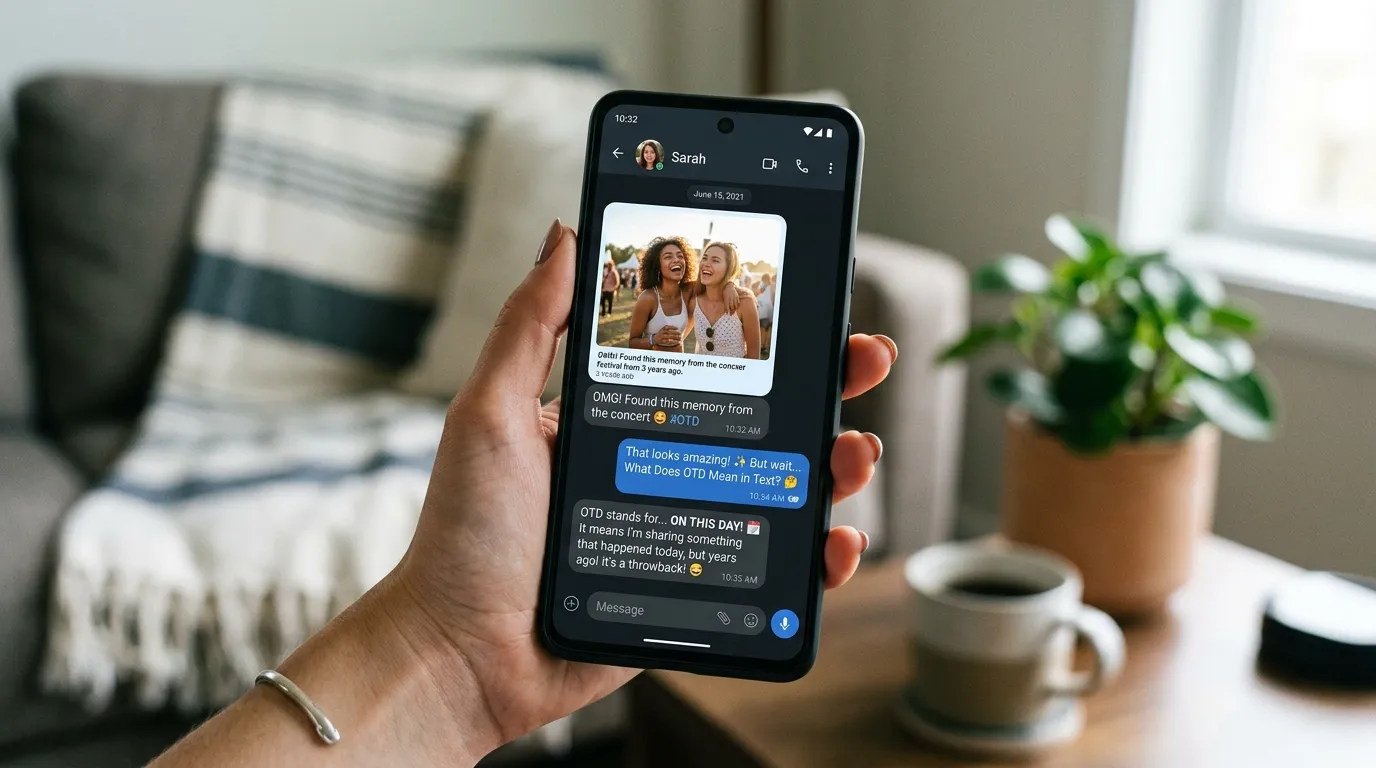
If someone texted you OTD and you had no idea what it meant, don’t worry you’re not alone. OTD most commonly means “On This Day” in text and across social media platforms.
People use it when sharing old memories, throwback photos, or past moments that happened on the same date in a previous year.
Understanding what OTD means in text is important because this abbreviation shows up everywhere on Instagram captions, Facebook posts, Twitter/X feeds, and even in casual DMs between friends.
It’s one of those short terms that feels confusing the first time you see it but makes total sense once you know it.
People search for OTD because texting slang changes fast and it’s easy to fall behind. Sometimes OTD can also mean “Out The Door” in business or shopping contexts, referring to a final price. In this guide, you’ll learn every meaning of OTD, where each version is used, and how to tell the difference.
OTD Meaning in Text
The most common meaning of OTD in text is “Of The Day.” It is an abbreviation used to describe something that is being featured or highlighted for that particular day.
For example, someone might post:
- Photo OTD
- Quote OTD
- Song OTD
- Workout OTD
In each case, OTD simply means that the person has chosen something as their favorite or featured item for that day.
Is OTD an Acronym or an Abbreviation?
OTD is generally considered an abbreviation rather than traditional slang. It shortens the phrase “Of The Day” into three letters, making messages and captions quicker to write.
Unlike internet slang such as LOL or BRB, OTD doesn’t express an emotion or reaction. Instead, it labels content that is connected to a specific day.
What Does OTD Mean in Everyday Chat?
In normal conversations, OTD helps point out something current or special.
Here are a few examples:
- “That’s my favorite song OTD.”
- “This is my coffee OTD.”
- “Here’s today’s meme OTD.”
- “That’s my book OTD recommendation.”
The exact meaning depends on the word that comes before OTD.
For example:
- Quote OTD = Quote of the Day
- Photo OTD = Photo of the Day
- Tip OTD = Tip of the Day
- Meal OTD = Meal of the Day
Because it’s flexible, people use OTD in many different ways across social media and messaging apps.
Can OTD Have Other Meanings?
Yes. Like many internet abbreviations, OTD can have different meanings depending on the context.
Some less common meanings include:
- Outfit of the Day Very popular on Instagram, TikTok, and fashion blogs.
- On This Day Used when sharing memories or historical events.
- Of The Day The most common general meaning in texting and captions.
For example:
“Here’s my OOTD.”
In this case, OOTD means Outfit Of The Day, which is slightly different from OTD. People sometimes shorten it to OTD in casual conversations, although OOTD is the more widely recognized fashion abbreviation.
The surrounding words usually make the intended meaning clear.
Why Do People Use OTD?
People use OTD because it’s:
- Short and easy to type
- Easy to understand once you know the meaning
- Popular across multiple social media platforms
- Useful for highlighting daily content
Instead of writing “Quote of the Day” every time, someone can simply write “Quote OTD.”
Is OTD Popular?
Yes. OTD is fairly common, especially among people who regularly use social media. It isn’t as famous as abbreviations like LOL, IDK, or BRB, but you’ll still see it in captions, hashtags, blogs, and text messages.
Its popularity increases around content that changes daily, such as:
- Daily motivation
- Fitness updates
- Fashion posts
- Food recommendations
- Bible verses
- Study tips
- News highlights
Because of its simple meaning, people of different ages can easily understand and use it.
Where People Use OTD
The meaning of OTD stays mostly the same across different platforms, but the way people use it can vary. Here’s where you’re most likely to see it.
OTD on TikTok
TikTok creators often use OTD in captions, videos, or hashtags to feature something from that day.
Examples include:
- Dance OTD
- Song OTD
- Makeup OTD
- Recipe OTD
- Bible Verse OTD
Creators use it to keep their content fresh and encourage viewers to return daily for new posts.
OTD on Snapchat
On Snapchat, OTD usually appears in Stories or direct messages.
Friends might send:
- “Selfie OTD 📸”
- “Mood OTD 😂”
- “Coffee OTD ☕”
Because Snapchat focuses on sharing moments from the day, OTD fits naturally into conversations and story updates.
OTD on Instagram
Instagram is one of the most common places to find OTD.
Influencers, brands, and everyday users include it in captions like:
- Photo OTD
- Quote OTD
- Bible Verse OTD
- Book OTD
- Workout OTD
Fashion creators may also use OOTD (Outfit Of The Day), which is closely related but more specific.
OTD on WhatsApp
WhatsApp users usually use OTD in family groups, work chats, or conversations with friends.
For example:
- “Here’s today’s prayer OTD.”
- “Tip OTD for studying.”
- “Recipe OTD if you’re cooking tonight.”
The abbreviation keeps messages short while clearly showing that the content is meant for that day.
OTD in SMS Text Messages
Although SMS doesn’t include hashtags or trending features, OTD still appears in personal conversations.
Someone might text:
- “Movie OTD?”
- “What’s your song OTD?”
- “Here’s my quote OTD.”
The abbreviation makes texting faster and avoids repeating the full phrase every time.
Why OTD Works So Well on Social Media
OTD has remained useful because it’s flexible. It can describe almost anything that changes daily, whether it’s a favorite song, a motivational quote, a photo, or a Bible verse.
Many creators also use it as part of a daily content series, helping followers know exactly what to expect each day. This simple abbreviation saves space in captions while making posts easy to understand.
As internet language continues to evolve, OTD remains one of those abbreviations that is easy to learn, simple to use, and recognized across multiple platforms.
Real Chat Examples
One of the easiest ways to understand OTD is by seeing how people actually use it in conversations. Below are realistic examples that show how the abbreviation fits naturally into everyday texting.
Example 1
A: Have you heard my song OTD?
B: Not yet. Which one is it?
A: It’s Birds of a Feather. I’ve had it on repeat all day.
Example 2
A: Here’s my quote OTD.
B: I like that one. It’s really motivating.
A: It helped me start the day with a positive mindset.
Example 3
A: Coffee OTD ☕
B: That looks amazing. Where did you get it?
A: From the new café near my office.
Example 4
A: Meme OTD 😂
B: That’s hilarious!
A: I couldn’t stop laughing when I saw it.
Example 5
A: Book OTD is Atomic Habits.
B: I’ve been meaning to read that.
A: You should it’s full of practical advice.
Example 6
A: My workout OTD is a 30-minute run.
B: Nice! I need to exercise more often.
A: Even a short walk makes a difference.
Example 7
A: Bible verse OTD: “Trust in the Lord with all your heart.”
B: I really needed to hear that today.
A: I’m glad it encouraged you.
Example 8
A: What’s your movie OTD?
B: I’m watching The Pursuit of Happyness.
A: Great choice! It’s one of my favorites.
Example 9
A: Meal OTD 🍕
B: That pizza looks delicious.
A: It tasted even better than it looks.
Example 10
A: What’s your OTD today?
B: My favorite song is “Lose Control.”
A: I’ll give it a listen later.
These conversations show that OTD usually introduces something the speaker wants to feature or recommend for that particular day.
How to Reply When Someone Says “OTD”
When someone sends OTD, your reply depends on what they’re sharing. Most of the time, they’re recommending something or showing their favorite item of the day.
Here are different ways you can respond.
Funny Replies
If you’re chatting with close friends, a humorous response can keep the conversation fun.
Examples:
- “Looks like we have the same OTD!”
- “That’s today’s winner for sure.”
- “Changing my OTD after seeing yours!”
- “Now you’ve made my choice harder.”
- “I think mine is even better!”
Funny replies work well when discussing music, food, memes, or movies.
Casual Replies
Casual responses are perfect for everyday conversations.
Examples:
- “Nice choice!”
- “I like that.”
- “That’s a good one.”
- “I’ll check it out.”
- “Sounds interesting.”
These replies are simple but keep the conversation moving naturally.
Friendly Replies
If you want to sound supportive or interested, try one of these.
Examples:
- “Thanks for sharing.”
- “I’ll definitely try that.”
- “Great recommendation!”
- “That actually looks really good.”
- “I’ll add it to my list.”
Friendly replies encourage more conversation and show genuine interest.
Neutral Replies
Sometimes you may just want to acknowledge the message politely.
Examples:
- “Good to know.”
- “Thanks.”
- “Noted.”
- “Interesting.”
- “I appreciate the suggestion.”
These are suitable when chatting with classmates, coworkers, or people you don’t know very well.
Which Reply Works Best?
There’s no single correct response.
If someone shares:
- Song OTD → Ask what they like about it.
- Quote OTD → Say it was inspiring.
- Movie OTD → Ask if it’s worth watching.
- Book OTD → Ask whether they’d recommend it.
- Bible Verse OTD → Thank them for sharing and discussing the verse if appropriate.
The best replies sound natural rather than forced.
Is OTD Rude or Offensive?
No. OTD is not considered rude or offensive.
It’s simply an abbreviation that helps people share something they’re featuring or recommending for the day.
Unlike some internet slang that can sound sarcastic or disrespectful, OTD is neutral.
Is It Safe to Use?
Yes.
OTD is generally safe to use in:
- Text messages
- Instagram captions
- TikTok posts
- Snapchat Stories
- WhatsApp chats
- Facebook posts
Since it doesn’t contain offensive language, most people won’t misunderstand it.
Can You Use OTD at School?
Yes.
Students often use OTD when sharing:
- Daily study tips
- Homework reminders
- Favorite books
- Motivational quotes
- School event photos
Teachers or classmates are unlikely to find the abbreviation inappropriate because its meaning is simple and respectful.
Is OTD Appropriate at Work?
In most workplaces, yes but context matters.
If you’re sending a casual team message like:
“Productivity Tip OTD”
or
“Safety Reminder OTD”
It’s perfectly acceptable.
However, in formal business emails or professional reports, writing out the complete phrase (such as “Tip of the Day”) may look more polished and easier for everyone to understand.
Could Someone Misunderstand OTD?
Sometimes.
Because OTD has multiple meanings, a reader might wonder whether you mean:
- Of The Day
- Outfit Of The Day
- On This Day
Usually, the surrounding words make the meaning obvious.
For example:
- Quote OTD → Quote of the Day
- Photo OTD → Photo of the Day
- Bible Verse OTD → Bible Verse of the Day
If you’re unsure whether your audience knows the abbreviation, you can simply write the full phrase the first time.
Should You Avoid Using OTD?
There’s no need to avoid it in everyday conversations.
However, consider writing the full phrase if:
- You’re speaking with someone unfamiliar with internet abbreviations.
- You’re writing an academic paper.
- You’re sending an important business document.
- Clarity is more important than saving a few characters.
In casual texting and social media posts, OTD is widely understood and perfectly acceptable.
Who Uses This Term?
Although OTD isn’t as famous as abbreviations like LOL or IDK, it’s still commonly used by people who spend time on social media and messaging apps.
Gen Z and Younger Users
Gen Z frequently uses OTD when posting:
- Daily photos
- Favorite songs
- Outfit ideas
- Bible verses
- Quotes
- Food recommendations
Short abbreviations fit naturally with the fast-paced style of modern social media.
Millennials
Many Millennials also use OTD, especially on Instagram, Facebook, and WhatsApp.
They often share:
- Parenting tips of the day
- Fitness updates
- Coffee photos
- Travel moments
- Daily reflections
Content Creators
Influencers, bloggers, YouTubers, and TikTok creators regularly include OTD in captions to feature daily content and keep followers engaged.
Examples include:
- Recipe OTD
- Workout OTD
- Reading OTD
- Prayer OTD
- Tip OTD
Everyday Users
You don’t need to be an influencer to use OTD.
Friends, students, coworkers, and family members use it in casual chats to recommend or highlight something they enjoy that day.
How Common Is OTD Online?
OTD appears regularly across:
- TikTok
- Snapchat
- X (formerly Twitter)
- SMS conversations
While it isn’t one of the most-used internet abbreviations, it’s common enough that many social media users recognize it without needing an explanation.
Origin of the Term
Like many internet abbreviations, OTD became popular because people wanted a faster way to communicate online. Instead of writing “Of The Day” every time, users shortened the phrase to just three letters.
The abbreviation first gained attention on blogs, online forums, and early social media platforms where people regularly shared daily recommendations, favorite songs, inspirational quotes, recipes, and photos. Writing “Quote OTD” or “Photo OTD” saves space while still making the message easy to understand.
As social media evolved, OTD became even more common on platforms like Instagram, TikTok, Snapchat, and Facebook. Today, content creators use it to organize daily posts and build routines that followers can recognize.
Internet Culture’s Influence
Internet culture has played a huge role in the popularity of abbreviations like OTD. Social media encourages short captions, quick messages, and easy-to-read content.
Instead of writing:
- Quote of the Day
- Song of the Day
- Book of the Day
people simply write:
- Quote OTD
- Song OTD
- Book OTD
This saves time while keeping captions clean and modern.
Is the Origin Clear?
Yes. Unlike some internet slang with uncertain origins, OTD has a very straightforward history. It simply comes from shortening the phrase “Of The Day.”
However, context still matters because some users may also use OTD to refer to “On This Day” or casually shorten “Outfit of the Day”, although OOTD remains the more common abbreviation for fashion posts.
Fortunately, the surrounding words almost always make the intended meaning clear.
Comparison Table
The table below compares OTD with several other popular internet abbreviations.
| Abbreviation | Meaning | Type | Common Usage | Popularity |
| OTD | Of The Day | Abbreviation | Sharing a daily favorite, recommendation, or featured item | Moderate |
| IDK | I Don’t Know | Acronym | Expressing uncertainty | Very High |
| IDC | I Don’t Care | Acronym | Showing indifference | Very High |
| IMO | In My Opinion | Acronym | Giving a personal opinion | High |
| BRB | Be Right Back | Acronym | Letting someone know you’ll return shortly | High |
Although OTD isn’t used as frequently as IDK or BRB, it’s still widely recognized by people who regularly use social media.
Real-World Usage Example
Imagine you’re chatting with friends in a group message about music.
One friend sends:
Song OTD: “Beautiful Things” by Benson Boone.
Another friend replies:
“That’s a great pick! I’ve been listening to it all week.”
A third friend joins in:
“Mine is ‘Lose Control.'”
Here, OTD simply introduces each person’s favorite song of the day. Everyone understands that they’re sharing today’s top recommendation rather than their all-time favorite.
The same idea works with books, movies, Bible verses, meals, workouts, travel photos, or motivational quotes. That’s why OTD is so versatile—it can be attached to almost anything people want to highlight for the day.
FAQS:
What does OTD mean in text messages?
In most text messages, OTD means “Of The Day.” People use it when sharing something they’re featuring or recommending for that particular day, such as a song, quote, meal, or photo.
What does OTD mean on TikTok?
On TikTok, OTD usually appears in captions or hashtags to highlight daily content. For example, creators may post a Song OTD, Recipe OTD, or Bible Verse OTD.
Is OTD slang?
Not exactly. OTD is better described as an abbreviation rather than slang. It shortens the phrase “Of The Day” into three letters.
Is OTD rude or offensive?
No. OTD is a neutral abbreviation and is not considered rude, offensive, or inappropriate. It’s safe to use in everyday conversations and on social media.
How should you reply to OTD?
The best reply depends on what the person is sharing. You can respond with comments like:
- “Nice choice!”
- “I’ll check that out.”
- “Thanks for sharing.”
- “That’s my favorite too!”
- “Looks great!”
Simple, friendly responses work best.
Conclusion:
Now you have a clear answer to what does OTD mean in text. In most cases, OTD stands for “On This Day” , a popular phrase used on social media when someone shares a memory or throwback from the past. It’s a warm, nostalgic way to connect with followers or friends by revisiting a meaningful moment.
In business and shopping conversations, OTD shifts to mean “Out The Door,” referring to the total final price of a product including all fees and taxes. Context always tells you which meaning applies.
OTD is completely appropriate for casual social media posts, friendly texts, and everyday online conversations. However, in formal emails or professional writing, it’s better to write out the full phrase to avoid confusion.
The next time you spot OTD in a caption, a DM, or a comment section, you’ll know exactly what it means. Simple abbreviations like this one are easy to master once you understand the context they’re used in.