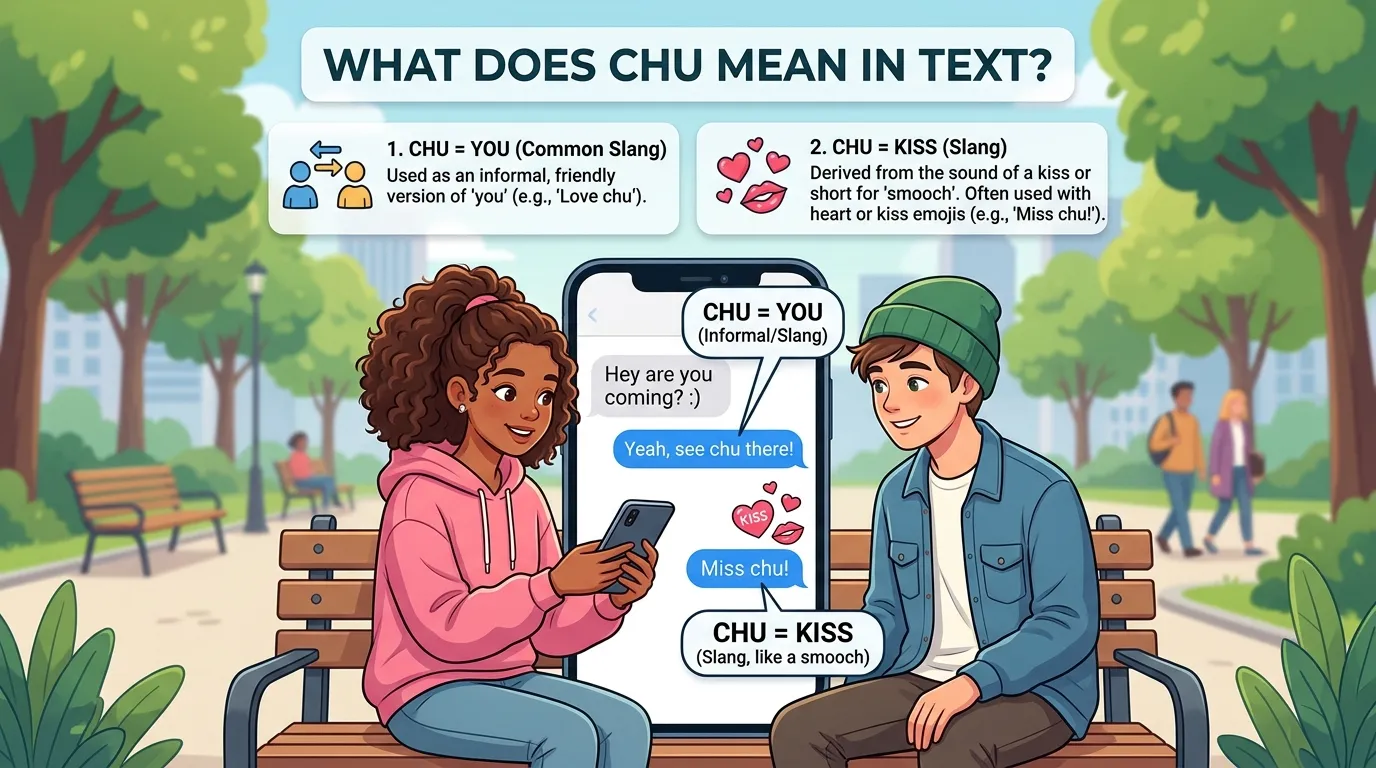
So, what does chu mean in text? Simply put, “chu” is a casual slang term that typically means “you” or represents the sound of a kiss, depending on the context of the conversation.
You’ve probably spotted “chu” popping up in text messages, social media comments, TikTok captions, or group chats. It’s the kind of word that feels obvious once you know it but genuinely confusing when you see it for the first time mid-conversation.
People use “chu” in two main ways. The first is as a shorthand for “you,” often written in phrases like “what chu doing?” or “I miss chu.” The second use mimics the sound of a quick kiss think of it as a written smooch, similar to “mwah.”
Most people search for this term because they received it in a message and weren’t sure how to respond. It’s especially common among younger texters and within close friendships or romantic conversations. Once you understand both meanings, reading it in context becomes pretty easy.
CHU Meaning in Text
The meaning of CHU in text is usually “you” or “you are,” depending on how it’s used in a sentence. Rather than being a formal abbreviation, it’s considered internet slang that gives messages a more playful and relaxed tone.
For example, someone might type:
- Miss Chu!
- I love Chu so much.
- How are chu today?
In each example, the word “chu” simply replaces “you.”
Is CHU an Acronym?
Most of the time, CHU is not an acronym. Unlike terms such as BRB (Be Right Back) or IDK (I Don’t Know), CHU doesn’t usually stand for separate words.
Instead, it’s a stylized spelling that became popular through online chatting and texting. Many people use it because it sounds cute, friendly, or affectionate.
However, it’s worth noting that CHU can have other meanings in different contexts. For example, it may refer to organizations, medical terms, or abbreviations in specific industries. But when you’re chatting on social media or texting a friend, it almost always means “you.”
What Does CHU Mean in Everyday Chat?
In everyday conversations, CHU is used to make messages feel warmer or more playful. Instead of typing “you,” someone may write “chu” to sound more affectionate.
Here are a few simple examples:
- I miss Chu already.
- Where is Chu going?
- Is Chu busy today?
- Can’t wait to see Chu!
- Thank you Chu for helping me.
As you can see, replacing “you” with “chu” doesn’t change the meaning of the sentence. It only changes the style and tone.
Why Do People Say CHU Instead of “You”?
There are several reasons why people choose to use CHU in text messages:
- It sounds cute and friendly.
- It makes conversations feel more personal.
- It’s popular in online communities and fandoms.
- It’s common in playful relationships and close friendships.
- It helps messages feel less formal.
Many internet slang terms become popular simply because they sound fun. CHU is one of those expressions that spread naturally through texting and social media.
Is CHU Common?
CHU isn’t as common as abbreviations like LOL, OMG, or BRB, but it’s still recognized by many people who spend time online.
You’ll usually notice it:
- In casual text conversations
- Between close friends
- In romantic messages
- On social media comments
- In fan communities
- Occasionally in memes
Because it has a lighthearted tone, it isn’t something people normally use in professional conversations.
Where People Use CHU
The meaning of CHU stays mostly the same across different platforms. It generally means “you” and adds a friendly or affectionate tone to a message. However, the way people use it can vary slightly depending on where they’re chatting.
CHU on TikTok
TikTok is one of the biggest places where internet slang spreads quickly. Users often include CHU in captions, comments, and videos to make their content sound playful.
Examples include:
- “Miss chu already ❤️”
- “Love chu guys!”
- “Can’t believe chu did that 😂”
Creators often use informal language because it feels more personal and connects better with their audience.
CHU on Snapchat
Snapchat conversations are usually short and casual, making CHU a natural fit.
Friends may send messages like:
- “Where chu at?”
- “Did Chu see my snap?”
- “Miss Chu.”
Since Snapchat focuses on private conversations, people often use relaxed slang instead of proper grammar.
CHU on Instagram
On Instagram, CHU appears in comments, captions, direct messages, and story replies.
For example:
- “Love chu bestie!”
- “Miss chu so much.”
- “Hope chu have an amazing day.”
Many users enjoy using cute expressions to make their comments feel more genuine and friendly.
CHU on WhatsApp
WhatsApp is widely used for chatting with family and friends, so you’ll occasionally see CHU in personal conversations.
Examples include:
- “Are Chu free tonight?”
- “I’ll call Chu later.”
- “Thank chu for everything.”
Because WhatsApp messages are usually private, people often use informal spelling without worrying about grammar.
CHU in SMS Text Messages
Even though many people now use messaging apps, CHU still appears in traditional SMS texting.
Someone might send:
- “Miss Chu.”
- “Where is Chu going?”
- “Love chu lots.”
In text messages, the goal is usually to keep conversations quick, casual, and expressive.
Does CHU Mean the Same Everywhere?
In most online conversations, yes. Whether you’re using TikTok, Snapchat, Instagram, WhatsApp, or regular text messages, CHU almost always means “you” or “you are.”
The only time the meaning changes is when it’s used in a completely different context, such as an organization, abbreviation, or technical term. That’s why it’s always helpful to look at the surrounding conversation before deciding what someone means.
By understanding the context, you’ll usually recognize that CHU is simply a playful way of referring to “you,” making conversations feel warmer and more relaxed.
Real Chat Examples
The easiest way to understand CHU is by seeing how people use it in everyday conversations. In most cases, CHU simply replaces the word “you” and gives the message a friendly, playful, or affectionate tone.
Below are ten realistic texting examples.
Example 1
A: Hey, what are Chu doing?
B: Just watching Netflix.
A: Nice! Want to watch it together later?
Example 2
A: I miss Chu so much.
B: Aww, I miss you too!
A: We should meet this weekend.
Example 3
A: Are Chu coming tonight?
B: Yes, I’ll be there around 8.
A: Great, see you then!
Example 4
A: Thank you Chu for helping me yesterday.
B: You’re welcome! Anytime.
A: I really appreciate it.
Example 5
A: Love chu, bestie!
B: Love you too! ❤️
A: You’re the best.
Example 6
A: Where chu at?
B: I’m almost home.
A: Okay, text me when you arrive.
Example 7
A: Did Chu finish the assignment?
B: Almost. Just one more question left.
A: Good luck!
Example 8
A: Can’t believe Chu forgot my birthday! 😂
B: Oh no! I’m so sorry.
A: I’m just joking.
Example 9
A: Hope chu have an amazing day!
B: Thanks! You too.
A: Enjoy your weekend.
Example 10
A: Chu ready for the game?
B: Absolutely! I’ve been waiting all week.
A: Let’s go!
These examples show that CHU is used naturally in friendly conversations. It doesn’t change the meaning of the sentence—it simply makes the message feel more casual and personal.
How to Reply When Someone Says “CHU”
If someone sends you a message containing CHU, your reply depends on the conversation. Since CHU usually means “you,” you can respond just as you would if the person had written the standard spelling.
Here are some reply ideas for different situations.
Funny Replies
If the conversation is playful, these responses can keep the fun going.
- “Only if Chu promises pizza! 🍕”
- “Who, me? 😄”
- “Chu talking to me?”
- “That’s the sweetest thing I’ve heard today!”
- “Haha, you’re funny!”
Casual Replies
For everyday conversations, simple responses work best.
- “Sure!”
- “Sounds good.”
- “No problem.”
- “Thanks!”
- “I’ll be there.”
Friendly Replies
When chatting with close friends or family, these replies feel warm and natural.
- “Miss you too!”
- “Love you too!”
- “Hope you’re doing well!”
- “Thanks for checking in.”
- “Can’t wait to see you.”
Neutral Replies
Sometimes you just want to answer politely without adding extra emotion.
- “Okay.”
- “I understand.”
- “Thanks for letting me know.”
- “I’ll think about it.”
- “Have a great day.”
Should You Reply Using CHU Too?
You don’t have to.
If the other person says CHU, you can reply using either “you” or “chu.” Both are perfectly acceptable in casual conversations.
For example:
Friend: Miss Chu!
Reply 1: Miss you too!
Reply 2: Miss Chu too!
Both responses sound natural. It simply depends on your personal texting style.
Is CHU Rude or Offensive?
One of the most common questions people ask is whether CHU is considered rude.
The short answer is no.
In most conversations, CHU is a harmless slang term that makes messages sound friendlier or cuter. It isn’t an insult, offensive word, or inappropriate expression.
Is It Safe to Use?
Yes, CHU is generally safe to use with:
- Friends
- Close family members
- Romantic partners
- Online gaming friends
- Social media followers
Most people understand it as a playful version of “you.”
When Should You Avoid Using It?
Although CHU is harmless, it isn’t suitable for every situation.
Avoid using it in:
- Business emails
- Job applications
- School assignments
- Academic writing
- Professional workplace communication
- Formal customer service messages
In these situations, writing “you” is much more appropriate.
Can Someone Misunderstand CHU?
Occasionally, yes.
People who aren’t familiar with internet slang may wonder whether CHU is an abbreviation for something else. Because it has several meanings outside of texting, context is important.
For example:
Friend: Love chu ❤️
Almost everyone will understand this means “Love you.”
However, if CHU appears in a medical article, news report, or official document, it may refer to something completely different.
That’s why you should always consider where you saw the word before deciding what it means.
Is CHU Appropriate for School?
In casual messages between classmates, CHU is generally fine.
Example:
- “Can Chu send me today’s notes?”
However, teachers usually expect proper spelling in homework, essays, and emails. In academic settings, it’s better to write “you.”
Is CHU Appropriate at Work?
Not usually.
While coworkers who are close friends might occasionally joke using slang, professional communication should stay clear and formal.
Instead of writing:
- “Can Chu send the report?”
It’s better to write:
- “Can you send the report?”
Using proper language helps avoid confusion and creates a more professional impression.
Who Uses This Term?
Like many internet slang expressions, CHU is most common among people who spend time chatting online.
Although it isn’t one of the most widely used slang terms today, it still appears regularly in casual conversations.
Younger Users
Teenagers and young adults are the biggest users of CHU.
Many enjoy playful spellings because they make conversations feel more expressive and fun.
Gen Z Usage
Gen Z often experiments with creative spelling, emojis, abbreviations, and internet slang.
Instead of writing:
- “I love you.”
They may write:
- “Love chu ❤️”
The meaning stays exactly the same, but the message feels a little more relaxed and affectionate.
Millennials
Some Millennials also use CHU, especially those who grew up using early internet chat rooms, messaging apps, and online forums.
However, many prefer the standard spelling “you.”
Older Adults
Older adults are less likely to use CHU regularly.
If they encounter the term, they may search online to understand its meaning, especially if a younger family member uses it in a text message.
Common Platforms
You’ll most often find CHU on:
- TikTok
- Snapchat
- Facebook Messenger
- Discord
- SMS text messages
- Online gaming chats
These platforms encourage quick, informal conversations where slang naturally develops.
How Often Does It Appear Online?
Compared to popular abbreviations like LOL, OMG, or BRB, CHU is relatively uncommon.
Even so, it still appears often enough that many social media users recognize it immediately.
Its popularity comes from sounding cute rather than saving typing time.
In other words, people use CHU because it adds personality to a conversation—not because it’s shorter than “you.”
Origin of the Term
Unlike many internet abbreviations, CHU doesn’t have a single, well-documented origin. Most language experts agree that it developed naturally through online conversations, where people often change spellings to make messages sound more expressive or affectionate.
Instead of writing “you,” some people began typing “chu” because it resembles the way “you” can sound in fast or playful speech. Over time, the spelling became popular in text messages, chat rooms, and social media.
Internet Culture and CHU
The internet has always encouraged creative language. New words, abbreviations, and spellings appear every year as users look for fun ways to communicate.
Terms like:
- LOL
- OMG
- BRB
- IDK
- TTYL
became popular because they were quick and easy to type. While CHU wasn’t created to save time, it became popular because it adds a friendly and playful feeling to messages.
For example:
- “Miss Chu!”
- “Love chu!”
- “Thank chu!”
These expressions often sound warmer than their standard versions, especially between close friends or romantic partners.
Is the Origin Certain?
Not completely.
There is no official record showing exactly who first used CHU or when it first appeared online. Like many slang terms, it likely spread gradually through online communities rather than being invented by one person.
Different websites may offer slightly different explanations, but they all point to the same general idea: CHU became popular through informal internet communication.
As social media continues to evolve, slang terms like CHU may become more common, change in meaning, or eventually fade from everyday use.
CHU vs Other Common Texting Abbreviations
Although CHU is often used in casual conversations, it’s different from many popular internet abbreviations. The table below highlights how it compares with some of the most common texting terms.
| Term | Meaning | Type | Usage | Popularity |
| CHU | You / You are (playful spelling) | Internet slang | Friendly chats, texting, social media | Moderate |
| IDK | I Don’t Know | Acronym | Everyday conversations | Very High |
| IDC | I Don’t Care | Acronym | Casual texting | High |
| IMO | In My Opinion | Acronym | Sharing opinions online | High |
| BRB | Be Right Back | Acronym | Chatting and messaging | Very High |
What Makes CHU Different?
Unlike IDK, IDC, IMO, and BRB, CHU isn’t usually an acronym.
Instead, it’s simply a playful alternative spelling of “you.”
That makes it unique among internet slang because its purpose isn’t to shorten a phrase—it simply changes the tone of a conversation.
Real-World Usage Example
Imagine two friends chatting after school.
Emma: “Hey, are Chu free this evening?”
Lily: “Yeah! What’s up?”
Emma: “Let’s grab some ice cream.”
Lily: “Sounds great! See Chu soon.”
In this conversation, both friends use CHU naturally because they’re speaking casually. If the same conversation happened in a work email or school report, they would almost certainly write “you” instead.
This example shows why understanding context is important. Casual slang works well among friends, but formal writing usually requires standard English.
FAQs:
What does CHU mean in text messages?
In most text messages, CHU simply means “you” or “you are.” It’s a playful spelling often used between friends, family members, or romantic partners.
What does CHU mean on TikTok?
On TikTok, CHU usually has the same meaning as in texting. People use it in captions, comments, and replies to sound friendly, cute, or affectionate.
Is CHU slang?
Yes. CHU is considered internet slang rather than a formal English word. It’s commonly used in casual online conversations.
Is CHU rude or offensive?
No. CHU is generally not rude or offensive. It’s a friendly expression that replaces the word “you.” However, it’s best avoided in professional or academic writing.
How should you reply to CHU?
Reply naturally based on the conversation. You can answer using either “you” or “chu.” For example:
- “Miss you too!”
- “Love chu too!”
- “Thanks!”
- “I’m doing great!”
Conclusion:
Understanding what chu means in text really comes down to reading the situation. When someone says “what chu up to?” they’re simply using a playful, relaxed way of saying “you.” When someone ends a message with “chu,” they’re likely sending a little virtual kiss your way.
This term shows up most often in casual, friendly, or flirty conversations. You wouldn’t typically see it in professional emails or formal settings, and that’s perfectly fine slang where people feel comfortable and relaxed with each other.
If someone younger or someone close to you sends it, don’t overthink it. It’s an affectionate or laid-back expression with no negative meaning behind it.
The next time “chu” appears in your messages, check the surrounding words for context. Is it replacing “you” in a sentence, or does it stand alone? That quick check will tell you everything you need to know. Slang evolves fast, but once you crack the simple patterns, keeping up gets a whole lot easier.

Jonathan Reed is a Biblical researcher and writer at askmeanings.com helping readers discover the deeper meanings of Scripture and Christian teachings.