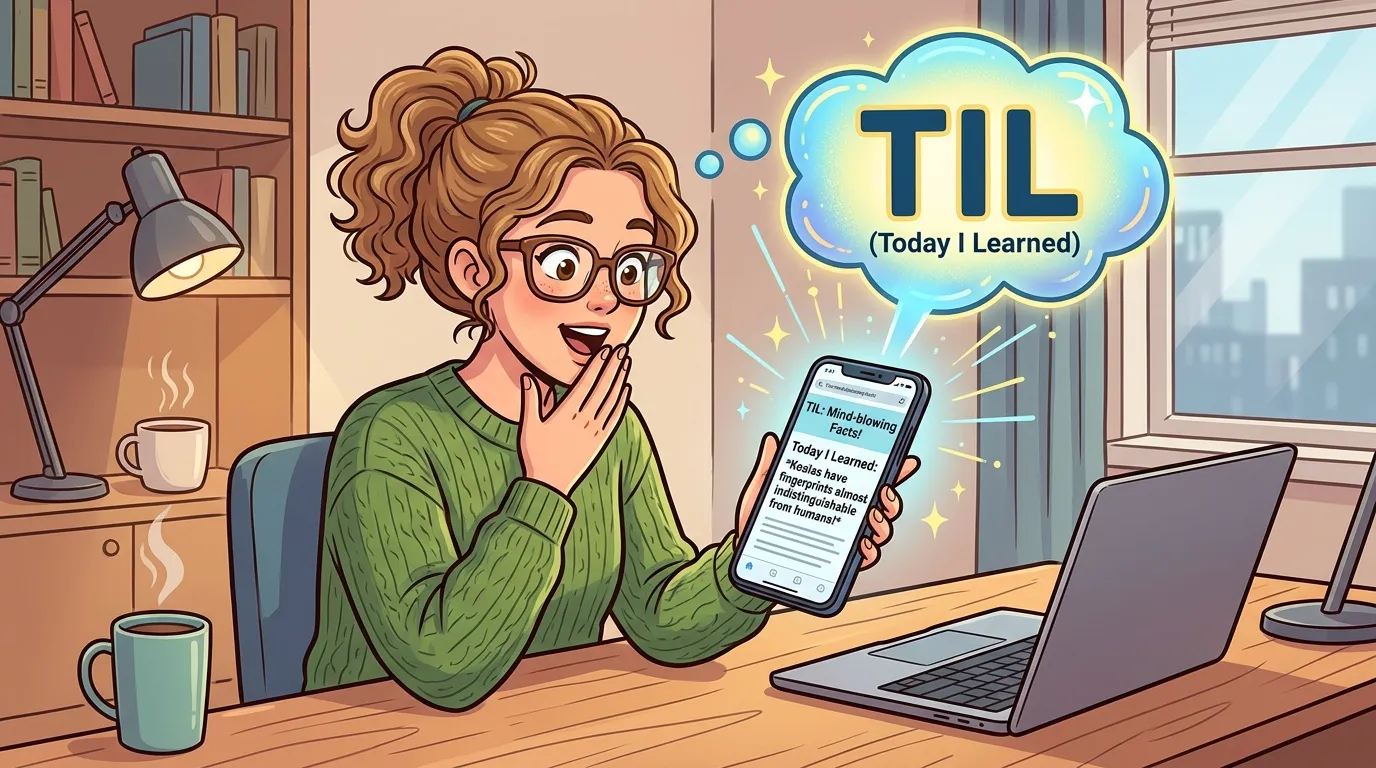
If you saw TIL in a post or message and were not sure what it meant, the answer is actually pretty exciting. TIL most commonly stands for “Today I Learned” in text messages and online conversations. People use it when they discover a surprising, interesting, or little-known fact they want to share with others right away.
Understanding what TIL means in text is useful because this abbreviation shows up constantly on Reddit, Twitter/X, Instagram captions, Facebook posts, and everyday text conversations. It is one of the most popular ways people share surprising discoveries or fun facts in a short and engaging way.
People search for TIL because it looks simple but is not immediately obvious the first time you see it. TIL can also mean “Until” in some casual texting conversations, though this usage is far less common today. Context makes it easy to tell the difference between the two. This guide covers every meaning of TIL clearly with real examples so you always know exactly what someone means when they use it.
TIL Meaning in Text
In texting, TIL stands for “Today I Learned.” It tells other people that the sender has recently discovered something they didn’t know before. Instead of simply saying, “I learned something today,” people shorten it to TIL because it’s faster and more common in online conversations.
For example:
TIL that octopuses have three hearts.
In this sentence, the writer is sharing an interesting fact they learned today.
Although the phrase says “today,” people don’t always use it literally. Sometimes they learned the information yesterday, last week, or even years ago but only decided to share it now. The expression simply introduces a new piece of information.
Is TIL a Slang Word?
Not exactly.
TIL is an acronym because it uses the first letter of each word in the phrase Today I Learned.
Many people also call it internet slang because it became popular through online communities. While both descriptions are common, “acronym” is technically the most accurate.
Unlike slang words that change meaning depending on the situation, TIL has stayed consistent for many years. Almost everyone who uses it understands it to mean that someone is sharing a newly learned fact.
What Does TIL Mean in Everyday Chat?
In everyday conversations, TIL adds context before sharing something interesting.
Instead of saying:
“I just found out honey never spoils.”
Someone might write:
“TIL honey never spoils.”
The abbreviation makes the message shorter while showing excitement about learning something new.
People often use TIL when they discover:
- Interesting science facts
- Historical information
- Technology tips
- Life hacks
- Surprising statistics
- Language meanings
- Fun trivia
Because of this, TIL has become one of the internet’s favorite ways to introduce educational content.
Does TIL Always Mean “Today I Learned”?
Most of the time, yes.
In general texting and social media, Today I Learned is by far the most common meaning.
However, in rare situations, TIL may have different meanings depending on the industry or community. For example, in business or technical discussions, the letters might stand for something completely different.
That’s why context always matters.
If someone writes:
TIL that penguins propose with pebbles.
It’s obvious they’re using the popular internet meaning.
If the conversation is about software, engineering, or a company project, TIL could refer to a technical term instead.
Why Is TIL So Popular?
TIL became popular because people love sharing knowledge.
Instead of writing a long introduction before explaining something, users can simply begin with “TIL,” and everyone immediately knows that an interesting fact is coming next.
This simple abbreviation encourages curiosity and makes educational content feel casual and fun.
You’ll often see TIL before:
- Weird animal facts
- Psychology discoveries
- Health information
- Movie trivia
- Geography facts
- Bible history facts
- Language meanings
- Everyday life tips
Many educational creators also use TIL because it catches people’s attention quickly.
When Should You Use TIL?
You can use TIL whenever you want to tell someone about something you recently discovered.
For example:
- You learned a cooking tip.
- You found a hidden phone feature.
- You discovered an interesting Bible fact.
- You read a surprising history article.
- You learned a new English word.
- You found out how something works.
Using TIL makes your message feel natural and conversational.
Here are a few examples:
- TIL dolphins recognize themselves in mirrors.
- TIL bananas are technically berries.
- TIL the Eiffel Tower grows slightly taller in summer.
- TIL there are more trees on Earth than stars in our galaxy.
These short posts invite people to read and often encourage others to comment with facts of their own.
Where People Use TIL
Although TIL started becoming popular on internet forums, it is now used across almost every major social media platform and messaging app. Here’s how people commonly use it in different places.
TIL on TikTok
TikTok creators often begin videos with TIL before revealing an interesting fact.
For example:
TIL that sharks existed before trees.
The abbreviation works well because it creates curiosity. Viewers naturally want to keep watching to learn something new.
Educational creators, history channels, science pages, and trivia accounts use TIL frequently in video captions and comments.
TIL on Snapchat
On Snapchat, TIL usually appears in chats between friends.
Someone might send:
TIL you can pin conversations on Snapchat.
Or they may share a screenshot of an interesting article with the caption:
TIL this actually works.
Since Snapchat conversations are informal, TIL fits naturally into everyday chats.
TIL on Instagram
Instagram users often include TIL in captions, Stories, Reels, or comments.
For example:
TIL flamingos aren’t naturally pink.
Many educational pages also use TIL at the beginning of carousel posts to introduce facts in a simple and engaging way.
Because Instagram encourages short, eye-catching captions, the abbreviation has become quite common.
TIL on WhatsApp
WhatsApp users mainly use TIL in conversations with friends, family members, classmates, or coworkers.
Examples include:
- TIL you can edit sent messages now.
- TIL this shortcut saves so much time.
- TIL coffee beans are actually seeds.
People also use it when forwarding interesting facts or helpful tips to group chats.
TIL in SMS Text Messages
Traditional text messages still include abbreviations because they’re quick and convenient.
A simple conversation might look like this:
TIL our local museum is free every Sunday.
Or:
TIL my phone has this feature and I’ve owned it for two years!
Using TIL saves time while making the conversation feel more relaxed and modern.
Why Context Matters
Even though today I learned the meaning you’ll see most often, always pay attention to the conversation.
If someone is discussing internet culture, social media, or sharing an interesting fact, TIL almost certainly means Today I Learned.
In specialized fields such as business, healthcare, or technology, the same letters can occasionally represent different terms. Reading the surrounding messages will help you understand which meaning is intended.
For everyday texting, however, you can safely assume that TIL means “Today I Learned.”
Real Chat Examples
The best way to understand TIL is by seeing how people use it in everyday conversations. Below are 10 realistic texting examples that show how naturally this abbreviation fits into online chats.
Example 1
A: TIL that koalas sleep up to 20 hours a day.
B: Seriously? That’s almost the whole day!
A: I know! I had no idea until today.
Example 2
A: TIL you can edit messages after sending them on WhatsApp.
B: Wait, really? I need to try that.
A: It makes fixing typos so much easier.
Example 3
A: TIL honey never expires if it’s stored properly.
B: That’s amazing. I thought it would go bad eventually.
A: Scientists have even found edible honey in ancient tombs.
Example 4
A: TIL the Eiffel Tower gets slightly taller during summer.
B: How does that happen?
A: The metal expands in warm temperatures.
Example 5
A: TIL that penguins give pebbles as gifts to their partners.
B: That’s actually adorable.
A: Nature is full of surprises.
Example 6
A: TIL bananas are technically berries.
B: No way! I always thought they were regular fruit.
A: I was surprised too.
Example 7
A: TIL my phone has a built-in document scanner.
B: You’ve had that phone for two years!
A: Better late than never.
Example 8
A: TIL that sharks existed before trees.
B: That sounds impossible.
A: I looked it up, and it’s true.
Example 9
A: TIL there’s a shortcut that copies screenshots directly to the clipboard.
B: That will save me so much time.
A: I’ve already started using it.
Example 10
A: TIL the blue whale is the largest animal ever to live on Earth.
B: Bigger than dinosaurs?
A: Yes, even bigger than most dinosaurs.
How to Reply When Someone Says “TIL”
When someone sends TIL, they’re usually sharing something they recently learned. You don’t have to respond in a special way. A simple reaction or follow-up question works perfectly.
Here are some ideas depending on the tone of the conversation.
Funny Replies
If you’re chatting with close friends, a humorous reply can keep the conversation entertaining.
Examples:
- My brain just leveled up.
- Guess we both learned something today.
- I refuse to believe that!
- Internet facts never disappoint.
- Now I have to tell everyone I know.
Funny replies work best in casual conversations where everyone enjoys joking around.
Casual Replies
These are simple responses you can use with friends or classmates.
Examples:
- That’s interesting.
- I didn’t know that either.
- Thanks for sharing.
- Good to know.
- I’ll remember that.
Casual replies keep the conversation flowing without sounding overly formal.
Friendly Replies
A friendly response shows genuine interest and often encourages more conversation.
Examples:
- That’s a really cool fact.
- Thanks for teaching me something new.
- I love learning random facts like this.
- That’s actually fascinating.
- You always find interesting information.
These replies make the conversation feel warm and engaging.
Neutral Replies
Sometimes you simply want to acknowledge the message politely.
Examples:
- Interesting.
- Noted.
- Thanks for the information.
- That’s helpful.
- I appreciate you sharing that.
Neutral replies are suitable when talking with coworkers, teachers, or people you don’t know very well.
Is TIL Rude or Offensive?
No. TIL is generally not rude or offensive.
It’s simply an abbreviation that introduces something the speaker has recently learned. Most people see it as friendly, informative, and educational.
Is It Safe to Use?
Yes.
TIL is considered one of the safest internet abbreviations because it doesn’t contain offensive language or negative meanings.
Whether you’re talking to friends, family members, classmates, or coworkers, using TIL is usually completely acceptable.
For example:
- TIL that bamboo grows incredibly fast.
- TIL there’s an easier way to organize Google Docs.
- TIL this Bible verse has an interesting historical background.
None of these examples would be considered rude.
Can TIL Ever Sound Rude?
The abbreviation itself isn’t rude, but the message that follows it can affect the tone.
For example:
TIL you never read instructions.
This could sound sarcastic or critical because of the sentence after TIL—not because of the abbreviation itself.
Similarly:
TIL some people still don’t know this.
Depending on the context, this might come across as mocking or condescending.
In most situations, though, TIL is used to share facts rather than criticize others.
Is TIL Appropriate at School?
Yes.
Teachers and students often use TIL when discussing interesting educational facts.
Examples include:
- TIL that the human brain contains billions of neurons.
- TIL why eclipses happen.
- TIL how volcanoes are formed.
Because it encourages learning, many educators even use TIL as part of classroom discussions or online learning activities.
Is TIL Professional Enough for Work?
It depends on the workplace.
In casual workplace chats, internal messaging apps, or team discussions, TIL can make communication feel friendly.
For example:
TIL our software has a shortcut that saves several clicks.
However, in formal emails, reports, or client communications, it’s usually better to write the full phrase:
Today I learned…
or
I recently learned that…
Using the complete sentence sounds more professional.
Who Uses This Term?
One reason TIL has remained popular is that it appeals to people of all ages who enjoy learning something new.
Teenagers and Students
Teenagers often use TIL when sharing fun facts with friends on social media or in group chats.
School students may also use it while discussing science, history, geography, or technology.
Gen Z Users
Gen Z uses TIL frequently across platforms like TikTok, Instagram, Reddit, Snapchat, and X.
Instead of writing long introductions, many users simply begin with “TIL” before revealing an interesting fact.
This makes posts feel short, engaging, and easy to read.
Millennials
Millennials helped popularize TIL through online communities and discussion forums.
Today, many still use it in social media posts, blogs, newsletters, and workplace messaging platforms.
Professionals
Although less common, professionals sometimes use TIL in internal chats to share useful discoveries.
Examples include:
- TIL this Excel shortcut saves several minutes.
- TIL our project management tool has a new feature.
This keeps team communication concise and helpful.
Content Creators
Educational creators love using TIL because it instantly sparks curiosity.
You’ll often see titles like:
- TIL this ancient city is older than the pyramids.
- TIL octopuses have blue blood.
- TIL this hidden phone setting improves battery life.
Starting with TIL encourages people to keep reading or watching.
How Common Is TIL Online?
TIL has become one of the most recognizable internet abbreviations.
You’ll regularly find it on:
- Reddit discussions
- TikTok captions
- Instagram Reels
- Facebook posts
- Snapchat chats
- WhatsApp groups
- X (formerly Twitter)
- Discord servers
- Online forums
- Blog comments
Although newer slang appears every year, TIL has remained popular because learning new things never goes out of style.
Origin of the Term
The exact origin of TIL isn’t completely certain, but most people agree that it became widely popular through early internet communities.
Before social media became as large as it is today, users on discussion forums often shared interesting facts they had just discovered. Instead of writing “Today I learned,” many shortened the phrase to TIL to save time.
As online conversations became faster, the abbreviation spread across blogs, message boards, and technology forums. It eventually gained even more attention through Reddit, where users frequently posted surprising facts beginning with TIL.
Over time, the expression expanded beyond forums and became common on platforms like TikTok, Instagram, Snapchat, Facebook, WhatsApp, and X. Today, millions of people recognize TIL as a simple way to introduce a newly learned fact.
Even though internet slang changes quickly, TIL has remained popular because its meaning is clear, positive, and easy to understand. Rather than replacing standard English, it complements casual online conversations by making information sharing shorter and more engaging.
Comparison Table
Many texting abbreviations look similar, but they have very different meanings. The table below compares TIL with some of the most common internet acronyms.
| Abbreviation | Meaning | Type | Common Usage | Popularity |
| TIL | Today I Learned | Acronym | Sharing a new fact or recent discovery | Very High |
| IDK | I Don’t Know | Acronym | Expressing uncertainty or lack of knowledge | Very High |
| IDC | I Don’t Care | Acronym | Showing indifference or lack of concern | Very High |
| IMO | In My Opinion | Acronym | Sharing a personal opinion or viewpoint | High |
| BRB | Be Right Back | Acronym | Letting someone know you’ll return shortly | Very High |
How TIL Is Different from Other Texting Acronyms
Although all five abbreviations are common in online conversations, they serve different purposes.
- TIL introduces something you’ve recently learned.
- IDK tells someone you don’t know the answer.
- IDC expresses that something isn’t important to you.
- IMO makes it clear you’re sharing a personal opinion rather than a fact.
- BRB lets others know you’re stepping away for a short time.
Knowing these differences can help you understand text messages more easily and avoid confusion.
Real-World Usage Example
Imagine you’re scrolling through TikTok during your lunch break. A creator posts a short educational video with the caption:
TIL that the fingerprints of a koala are so similar to humans that they can be difficult to tell apart.
You watch the video because the opening catches your attention. After learning the fact, you send it to your friend on WhatsApp and write:
TIL something really interesting today!
Your friend replies:
I never knew that either!
This is exactly how TIL is used in everyday online conversations. It introduces a new piece of information and encourages others to react, ask questions, or share their own discoveries.
Here’s another example from everyday life.
You’re working on your laptop and accidentally discover a keyboard shortcut that saves time. Excited about your discovery, you post on X:
TIL you can quickly reopen a closed browser tab with Ctrl + Shift + T.
People reply with comments like:
- “I’ve been using a computer for years and never knew this!”
- “Thanks for sharing.”
- “That’s going to save me a lot of time.”
This simple example shows why TIL has remained popular. It turns ordinary discoveries into useful conversations.
Tips for Using TIL Naturally
If you’re new to internet slang, using TIL is very easy. Here are a few simple tips.
Share Something Interesting
People expect a useful or surprising fact after TIL.
For example:
- TIL sea otters hold hands while sleeping.
- TIL tomatoes are botanically classified as fruits.
- TIL some bamboo species can grow several feet in a single day.
Interesting facts make your post more engaging.
Keep It Short
TIL works best with short, easy-to-read sentences.
Instead of writing a long paragraph, introduce the fact quickly and let readers explore further if they want.
Make Sure the Information Is Accurate
Before posting a surprising fact, try to verify it using a reliable source. Sharing correct information helps build trust, especially if you create educational content.
Consider Your Audience
TIL is perfect for friends, classmates, and social media followers. In formal reports or business emails, it’s usually better to write the full phrase “Today I learned” or simply explain what you discovered.
Common Mistakes People Make
Even though TIL is easy to use, beginners sometimes make a few mistakes.
Thinking TIL Means Something Negative
Some people assume TIL is a sarcastic or insulting abbreviation. In reality, it usually has a positive meaning and simply introduces new information.
Believing It Must Mean You Learned It Today
The phrase says “today,” but people often use TIL for facts they discovered recently, even if it wasn’t literally today.
Confusing TIL with Similar Acronyms
Because internet slang contains hundreds of abbreviations, some users mix up TIL with terms like TL;DR or TMI. Each abbreviation has a completely different meaning, so context is important.
Using It in Very Formal Writing
TIL is best suited for casual conversations, text messages, and social media. In professional documents or academic papers, writing the full sentence is usually a better choice.
FAQs:
What does TIL mean in text messages?
In text messages, TIL stands for “Today I Learned.” It’s used to introduce a new fact, discovery, or interesting piece of information that the sender recently learned.
What does TIL mean on TikTok?
On TikTok, TIL usually appears in captions or videos that teach viewers something new. Creators use it to grab attention before sharing fun facts, life hacks, history, science, or educational content.
Is TIL slang?
TIL is primarily an acronym, although many people also refer to it as internet slang because it’s commonly used in casual online conversations.
Is TIL rude or offensive?
No. TIL is not considered rude or offensive. It’s a friendly abbreviation used to share information and is generally safe to use in everyday conversations.
How should you reply to TIL?
You can reply in several natural ways, depending on the conversation.
Some common responses include:
- That’s interesting!
- I didn’t know that either.
- Thanks for sharing.
- That’s a cool fact.
- I’ll remember that.
Any positive or curious response works well.
Final Thoughts:
By now, you know that TIL means “Today I Learned.” It’s a simple internet acronym people use to introduce a new fact, interesting discovery, or useful piece of information.
You’ll commonly see it on TikTok, Snapchat, Instagram, WhatsApp, Reddit, X, Facebook, and in everyday text messages. Because it’s short and easy to understand, TIL has become one of the internet’s most recognizable abbreviations.
In most situations, TIL is friendly, safe, and appropriate for casual conversations. It’s a great way to share something you’ve recently learned or start an engaging discussion with others.
The next time someone sends you a message beginning with TIL, you’ll know they’re simply sharing something they found interesting and you might even learn something new yourself.

Jonathan Reed is a Biblical researcher and writer at askmeanings.com helping readers discover the deeper meanings of Scripture and Christian teachings.