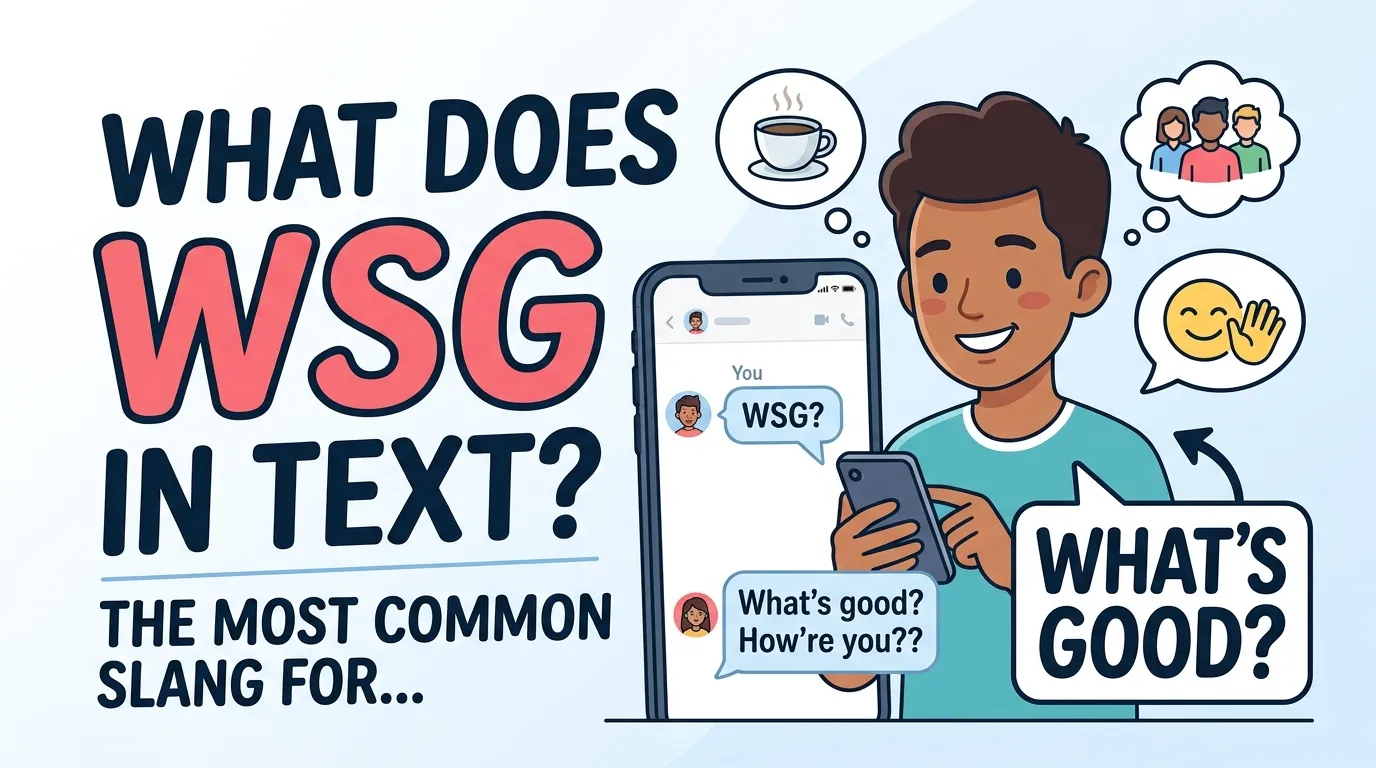
If someone sent you WSG and you had no idea what it meant, you are not alone. WSG stands for “What’s Good” a casual, friendly greeting used in everyday texting and across social media platforms. It is simply a cool and laid-back way of asking how someone is doing or what is going on in their life.
Understanding what WSG means in text is important because this abbreviation pops up constantly on Snapchat, Instagram DMs, TikTok comments, WhatsApp chats, and everyday text conversations, especially among teens and young adults. It carries a warm, positive, and welcoming vibe that makes it one of the most popular greetings in modern texting culture.
People search for WSG because short slang terms can feel confusing without context. Once you know what it means, using and responding to WSG feels completely natural. This guide covers the real meaning, real examples, and exactly how WSG is used across every major platform today
WSG Meaning in Text
In texting, WSG most commonly stands for “What’s Good?” It is a casual greeting that asks someone how they are doing or what they are up to. Rather than asking a formal question, it’s a relaxed way to start a conversation with friends or people you know well.
For example:
- WSG bro?
- WSG tonight?
- Hey, WSG?
In each example, the sender is simply starting a conversation or checking in.
Is WSG an Acronym or Slang?
WSG is considered both an internet acronym and text slang.
- Acronym: It represents the phrase “What’s Good?”
- Slang: It is an informal expression mostly used in casual online conversations.
Unlike formal greetings such as “Hello” or “Good afternoon,” WSG has a friendly and modern tone. It’s especially popular among younger users who communicate through social media and messaging apps.
What Does “What’s Good?” Really Mean?
Even though the words literally ask “What’s good?”, the phrase rarely expects someone to list things that are good.
Instead, it usually means one of the following:
- How are you?
- What’s up?
- What’s happening?
- What are you doing?
- What’s new?
The exact meaning depends on the conversation.
For example:
Friend: WSG?
This could simply mean:
- How’s your day going?
- What are you doing right now?
- Want to chat?
Everyday Uses of WSG
People use WSG in many casual situations, including:
- Greeting a friend after school
- Starting a Snapchat conversation
- Sending a late-night text
- Joining a gaming chat
- Checking if someone is available
Here are a few natural examples:
Example 1
A: WSG?
B: Just watching Netflix.
Example 2
A: WSG tonight?
B: Thinking about going out.
Example 3
A: Yo, WSG?
B: Not much. You?
These examples show that WSG works much like “What’s up?” or “How’s it going?”
Different Meanings Based on Context
Although “What’s Good?” is by far the most common meaning, context always matters.
For example:
“WSG everyone!”
Here, it simply means “Hello everyone!”
“WSG this weekend?”
This asks about someone’s plans.
“WSG with you?”
This means “What’s going on with you?”
As you can see, the basic idea stays the same even though the wording changes slightly.
Why Is WSG So Popular?
People like internet slang because it’s fast and easy to type.
Instead of writing:
“Hey, how are you doing today?”
Many people simply type:
“WSG?”
It’s short, friendly, and feels natural in online conversations.
Another reason for its popularity is that social media encourages quick interactions. Short greetings fit perfectly into texting, Snapchat streaks, Instagram DMs, and TikTok comments.
Where People Use WSG
WSG appears on many different social media platforms and messaging apps. Although the meaning stays nearly the same everywhere, people may use it slightly differently depending on the platform.
WSG on TikTok
TikTok users often use WSG in comments, captions, and direct messages.
Someone might comment:
WSG 😂
This usually means:
- What’s up?
- What’s going on?
- Hey!
Creators may also write captions like:
WSG TikTok?
They’re simply greeting their audience before sharing a video.
In TikTok live streams, viewers also type WSG to greet the creator or start chatting with other viewers.
WSG on Snapchat
Snapchat is one of the most common places you’ll see WSG.
Instead of sending a long message, someone may simply snap:
WSG?
They’re asking if you’re free, checking how you’re doing, or trying to start a conversation.
For example:
A: WSG?
B: Just got home.
A: Nice. Wanna hop on a call?
Because Snapchat conversations are quick and informal, WSG fits naturally into everyday chats.
WSG on Instagram
On Instagram, WSG often appears in direct messages, story replies, and comments.
Examples include:
- WSG bro?
- WSG today?
- WSG this weekend?
Friends also use it after replying to someone’s story to continue the conversation.
For example:
A: WSG? Saw your vacation pics!
B: Thanks! It was an amazing trip.
Instagram users often combine WSG with emojis to make messages feel even more casual.
WSG on WhatsApp
Although WhatsApp includes both personal and professional conversations, WSG is mainly used in chats between friends and family.
Someone may send:
WSG?
Instead of typing:
Hey, what are you doing?
It’s a quick way to check in without sounding too formal.
However, it’s generally better to avoid WSG in business or work-related WhatsApp conversations unless you know the other person well.
WSG in SMS Text Messages
Traditional text messages still include plenty of internet slang, and WSG is no exception.
Friends often use it when:
- Starting a conversation
- Asking someone to hang out
- Checking if someone is available
- Seeing what someone is doing
For example:
A: WSG later?
B: Nothing planned yet.
A: Want to grab dinner?
The abbreviation keeps messages short while sounding friendly and relaxed.
Real Chat Examples
The easiest way to understand WSG is by seeing how people use it in real conversations. Below are 10 natural texting examples that show how the abbreviation fits into everyday chats.
Example 1
A: WSG bro?
B: Not much, just got home from work.
A: Nice! Want to play a few games later?
Example 2
A: WSG today?
B: I’m heading to the gym.
A: Have a great workout!
Example 3
A: Yo, WSG?
B: Just watching TikTok.
A: Same here. Any good videos?
Example 4
A: WSG this weekend?
B: I’m visiting my cousins.
A: Sounds fun. Have a great time!
Example 5
A: WSG?
B: Nothing much. What’s up with you?
A: Just relaxing after class.
Example 6
A: WSG tonight?
B: Thinking about ordering pizza.
A: Count me in if you’re sharing!
Example 7
A: WSG everyone?
B: We’re waiting for the game to start.
A: Awesome, I’ll join in a minute.
Example 8
A: Hey, WSG?
B: Busy finishing homework.
A: Good luck! Talk later.
Example 9
A: WSG my guy?
B: Just got a new phone today.
A: That’s awesome! Which one did you get?
Example 10
A: WSG?
B: Just chilling at home.
A: Same. Want to watch a movie online?
How to Reply When Someone Says “WSG”
Since WSG simply means “What’s Good?” or “What’s up?”, your reply doesn’t need to be complicated. You can answer based on what you’re doing or how you’re feeling.
Here are several natural ways to respond.
Funny Replies
If you’re chatting with close friends, adding a little humor makes the conversation more enjoyable.
Some funny replies include:
- Just surviving Monday.
- Living my best life.
- Trying to become famous overnight.
- Waiting for someone to buy me pizza.
- Nothing… unless you have exciting news.
- Just pretending to be productive.
- Winning imaginary arguments in my head.
- Looking for free snacks.
Funny responses work best with friends who understand your sense of humor.
Casual Replies
Most people simply answer WSG with a relaxed response.
Examples include:
- Not much, you?
- Just chilling.
- Watching YouTube.
- At home right now.
- Working on homework.
- Just got back from work.
- Nothing special today.
- Relaxing after a long day.
These replies keep the conversation moving naturally.
Friendly Replies
If someone you know well sends WSG, you can respond warmly.
Examples:
- Hey! I’m doing great. How about you?
- Everything’s good here. What’s new with you?
- Just hanging out. How’s your day going?
- Good to hear from you!
- Nothing much. What have you been up to?
- Glad you texted. What’s happening?
Friendly responses help keep conversations positive and engaging.
Neutral Replies
Sometimes you want to answer politely without saying too much.
Neutral responses include:
- I’m doing well, thanks.
- Everything’s fine.
- Nothing new at the moment.
- Just working.
- Busy today.
- All good here.
- Same as usual.
- Just taking it easy.
These replies are suitable when you don’t know the other person very well.
Is WSG Rude or Offensive?
In most situations, WSG is not rude or offensive. It’s simply an informal greeting that people use to start conversations online.
Think of it as a modern version of saying:
- What’s up?
- How’s it going?
- Hey!
- What’s happening?
Because it’s so common on social media, most people understand it immediately.
Is It Safe to Use?
Yes. WSG is generally considered safe to use in casual conversations with friends, classmates, teammates, and family members.
You’ll often see it used in:
- Text messages
- Snapchat
- Instagram DMs
- TikTok comments
- Discord chats
- Gaming communities
It doesn’t contain offensive language or negative meaning by itself.
Can It Ever Sound Rude?
The abbreviation itself isn’t rude, but the tone of the conversation matters.
For example:
WSG?
can sound friendly.
However,
WSG?? Why aren’t you replying?
may sound impatient because of the additional message—not because of the abbreviation.
Like most internet slang, the surrounding words determine the tone.
Should You Use WSG at School?
With classmates or friends at school, WSG is perfectly normal.
However, it’s better to avoid using slang when communicating with:
- Teachers
- School administrators
- Professors
- Academic staff
A more formal greeting such as “Hello” or “Hi” is usually more appropriate.
Is WSG Appropriate at Work?
Generally, no.
While some coworkers may use internet slang in private chats, professional emails and workplace messages should remain formal.
Instead of saying:
WSG?
It’s better to write:
- Hi, how are you?
- Good morning.
- Hope you’re doing well.
Professional communication leaves a better impression.
Who Uses This Term?
WSG has become one of the most recognizable pieces of internet slang in recent years. Although people of different ages understand it, it’s especially popular among younger internet users.
Gen Z and Younger Millennials
Gen Z uses WSG more than any other age group.
Many teenagers and young adults grew up communicating through:
- Snapchat
- TikTok
- Discord
- Online games
Because quick abbreviations are common on these platforms, WSG feels natural in everyday conversations.
Millennials who actively use social media also understand and use the term, although they may still prefer greetings like “What’s up?”
Common Platforms
You’ll most often find WSG on:
- TikTok
- Snapchat
- Discord
- Messenger
- X (formerly Twitter)
- SMS text messages
It’s especially common in direct messages where conversations are short and informal.
Gaming Communities
Online gamers frequently greet teammates with WSG before starting a match.
For example:
WSG everyone?
or
WSG squad?
In this context, it’s simply another way of saying hello before playing together.
How Often Does It Appear Online?
WSG appears regularly across social media because it’s short, easy to type, and widely understood.
You’ll often notice it in:
- Comments
- Livestream chats
- Story replies
- Group chats
- Gaming servers
- Meme pages
As internet slang continues to evolve, WSG remains one of the most commonly used greetings among younger users.
Origin of the Term
Like many internet abbreviations, WSG developed from a phrase people were already saying in everyday speech.
The expression “What’s good?” has been part of informal English for many years, especially in casual conversations and urban slang. Instead of asking, “How are you?” people would simply say, “What’s good?” to greet friends.
As texting became more popular, users started shortening common phrases to save time. Just as people began using LOL, BRB, and IDK, the phrase “What’s Good?” was shortened to WSG.
The Influence of Internet Culture
Social media played a major role in making WSG popular.
Platforms like TikTok, Snapchat, Instagram, and Discord encourage fast, casual communication. Short abbreviations fit perfectly into comments, captions, and direct messages, making them easy to type and understand.
Content creators, influencers, and gamers also helped spread the term by using it in videos, livestreams, and online conversations.
Is the Exact Origin Known?
There isn’t one confirmed person or website that created WSG.
Instead, it appears to have evolved naturally as internet users looked for faster ways to communicate. Over time, the abbreviation became widely recognized, especially among younger audiences.
Today, WSG is considered a standard piece of internet slang and is understood by millions of social media users around the world.
Comparison Table
The table below compares WSG with several other common texting abbreviations. While they all appear frequently in online conversations, each one serves a different purpose.
| Term | Meaning | Type | Usage | Popularity |
| WSG | What’s Good? | Slang/Acronym | Greeting someone or asking what’s happening | Very High |
| IDK | I Don’t Know | Acronym | Expressing uncertainty or lack of knowledge | Very High |
| IDC | I Don’t Care | Acronym | Showing indifference or lack of preference | Very High |
| IMO | In My Opinion | Acronym | Sharing a personal opinion | High |
| BRB | Be Right Back | Acronym | Letting someone know you’ll return shortly | Very High |
Although these abbreviations are common in texting, they aren’t interchangeable. WSG is mainly used as a greeting, while the others express opinions, uncertainty, indifference, or a temporary absence.
When Should You Use WSG Instead of Other Slang?
Choosing the right abbreviation depends on the conversation.
Use WSG when you want to:
- Start a conversation.
- Greet a friend.
- Ask what someone is doing.
- Check in casually.
For example:
WSG?
This feels similar to saying:
- What’s up?
- How’s it going?
- What’s happening?
By contrast:
- IDK answers a question.
- IDC expresses that something doesn’t matter to you.
- IMO your opinion.
- BRB lets others know you’ll be away briefly.
Understanding these differences helps you use internet slang naturally and avoid confusion.
Real-World Usage Example
Imagine you’ve just finished school and want to see if your friend is free.
Instead of typing a long message, you simply send:
WSG?
Your friend replies:
Just got home. What’s up?
You answer:
Want to grab something to eat?
The conversation starts naturally with only one short abbreviation.
Here’s another example.
A college student notices a friend has posted a new Instagram Story from a concert. Curious, they send a direct message:
WSG! That concert looks amazing. How is it?
The friend replies:
It’s awesome! I wish you were here.
In gaming communities, WSG is equally common.
A player joins a Discord voice chat before a match and types:
WSG everyone? Ready to play?
Other players respond, and the game begins.
These situations show why WSG has become such a popular greeting. It’s quick, friendly, and works across different platforms without sounding overly formal.
FAQs:
What does WSG mean in text messages?
In text messages, WSG usually means “What’s Good?” It’s a casual way of asking someone how they’re doing or what they’re up to.
What does WSG mean on TikTok?
On TikTok, WSG is commonly used in comments, captions, livestream chats, and direct messages. It usually means “What’s up?” or “What’s going on?”
Is WSG slang?
Yes. WSG is considered internet slang as well as a texting acronym. It’s mainly used in informal online conversations.
Is WSG rude or offensive?
No. WSG is generally not rude or offensive. It’s a friendly greeting that is safe to use with friends and people you know. However, it’s usually best to avoid it in formal or professional conversations.
How should you reply to WSG?
You can reply naturally depending on what you’re doing.
Some common responses include:
- Not much, you?
- Just chilling.
- I’m good. What’s up?
- I’m working right now.
- Just got home.
- Everything’s good. How about you?
A simple, friendly response is usually all that’s needed.
Common Mistakes People Make with WSG
Although WSG is easy to use, beginners sometimes misunderstand it.
Here are a few common mistakes:
Thinking It Has a Hidden Meaning
Some people assume WSG has a secret meaning because they see it on social media. In reality, it almost always means “What’s Good?” and is simply a casual greeting.
Using It in Formal Conversations
WSG is perfect for chatting with friends, but it isn’t suitable for professional emails, job applications, or conversations with teachers unless you have an informal relationship.
Confusing It with Other Abbreviations
Because internet slang changes quickly, some users mix WSG with abbreviations like WYD (What You Doing?) or WSP (What’s Up?).
While these expressions are similar, they aren’t identical.
- WSG = What’s Good?
- WSP = What’s Up?
- WYD = What Are You Doing?
Understanding these small differences helps you communicate more naturally.
Tips for Using WSG Naturally
If you’re new to internet slang, these simple tips can help.
- Use WSG with friends or people you know well.
- Keep your reply short and natural.
- Match the other person’s casual tone.
- Don’t overuse slang in every conversation.
- Switch to more formal greetings when speaking with teachers, employers, or clients.
Using the right tone is just as important as understanding the abbreviation itself.
Final Thoughts:
Internet slang can seem confusing at first, but WSG is actually one of the easiest abbreviations to understand.
In most cases, it simply means “What’s Good?” a relaxed way of saying “What’s up?” or “How are you?” Friends commonly use it to start conversations on TikTok, Snapchat, Instagram, WhatsApp, Discord, and in regular text messages.
Because WSG is informal, it’s best suited for casual chats rather than professional or academic communication. If you’re talking with friends, classmates, or gaming partners, it’s a natural and friendly way to say hello.
Now that you know what WSG means, you’ll be able to recognize it instantly and respond with confidence whenever it appears in your messages or on social media.