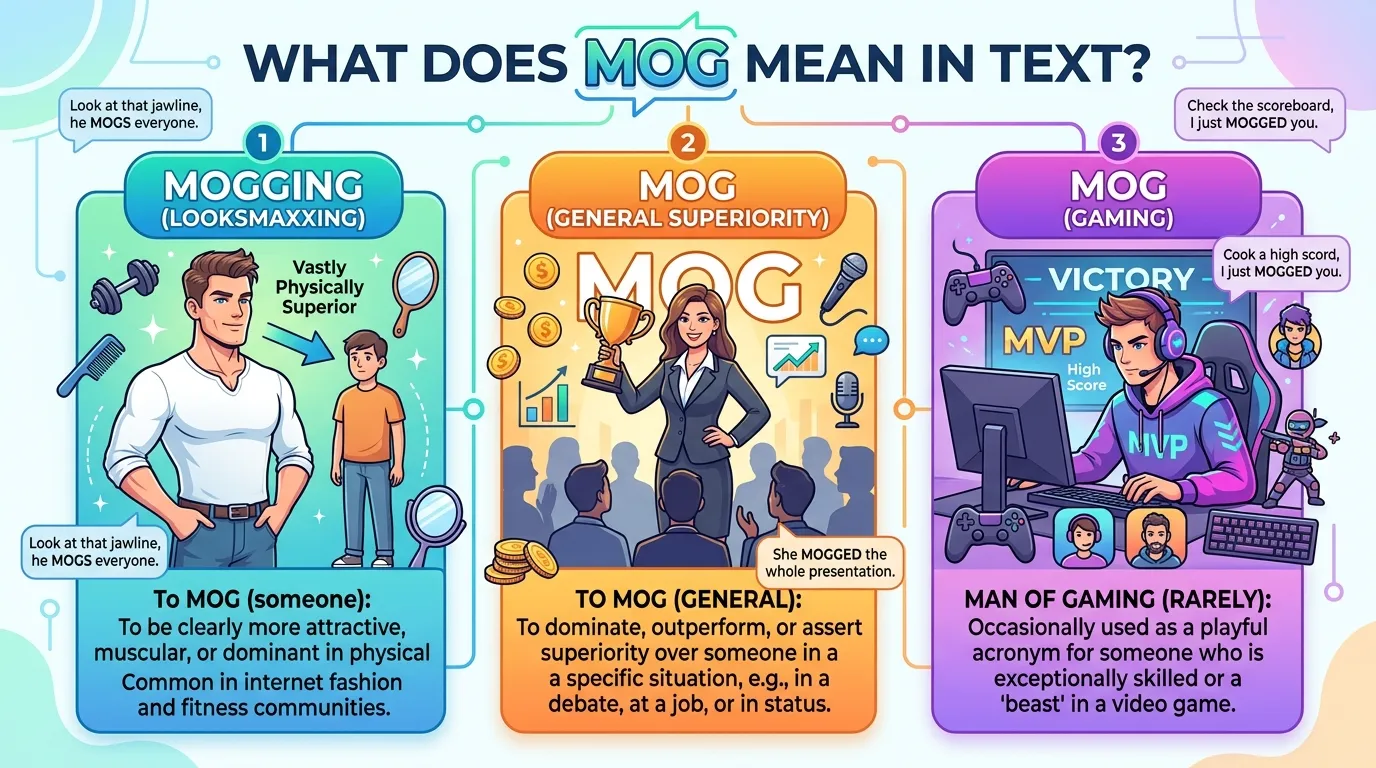
If someone used MOG in a message and you weren’t sure what it meant, you’ve come to the right place. MOG means “to dominate or outshine someone else” especially in looks, confidence, or overall presence. It’s a slang term that exploded in popularity on TikTok and spread quickly across Instagram, Twitter/X, and everyday texting.
Understanding what does MOG mean in text matters because this word is now a huge part of internet culture, especially among younger generations. When someone says they “mogged” another person, they mean they completely overshadowed them without even trying. It can be used as a verb, a noun, or even a compliment depending on the situation.
People search for MOG because it sounds unfamiliar the first time they see it. The term comes from the word “mog” rooted in online male fitness and self-improvement communities but has since gone mainstream. In this guide, you’ll get every meaning, real examples, and exactly how to use MOG correctly.
What Does MOG Mean in Text?
When someone says MOG in a text conversation, they usually mean that one person is significantly more attractive, stylish, or impressive than another.
For example:
“He totally mogged everyone at the party.”
This means the person stood out because of their appearance or overall presence.
Is MOG an Acronym?
Although many people assume MOG is an acronym, it’s generally considered internet slang rather than a traditional abbreviation.
The word comes from online communities where people compare physical appearance, confidence, fashion, or overall attractiveness. Today, it has spread far beyond those communities and appears regularly across social media.
Everyday Meaning of MOG
In normal conversations, MOG simply means:
- Looking much better than someone else
- Outshining another person
- Being more attractive
- Having a stronger presence
- Impressing everyone around you
For example:
- “She mogged everyone in that photo.”
- “That new haircut completely mogs your old look.”
- “He walked into the room and instantly mogged everybody.”
In most situations, people use the word playfully rather than seriously.
What Does “Mogged” Mean?
You’ll also see the past tense mogged quite often.
Examples include:
- “I got mogged.”
- “He was completely mogged.”
- “Our whole friend group got mogged by him.”
In these examples, “mogged” means someone else looked noticeably better or attracted more attention.
Why Is MOG Popular?
People enjoy using short slang words that quickly express an idea.
Instead of writing:
“That person looks much more attractive than everyone else.”
They simply say:
“He mogs everyone.”
The shorter phrase feels more natural in fast-moving online conversations.
Where People Use MOG
MOG isn’t limited to one app. You’ll find it across several social media platforms and messaging apps.
TikTok
TikTok is one of the biggest places where MOG appears.
Users often comment:
- “Bro mogged everyone.”
- “Absolute mog.”
- “He’s the final boss of mogging.”
Creators also use the word in glow-up videos, fashion edits, gym transformations, hairstyle comparisons, and confidence-related content.
If someone posts a dramatic before-and-after transformation, comments often mention MOG because viewers think the person now looks much more attractive.
Snapchat
On Snapchat, MOG usually appears in private chats between friends.
Examples include:
- “You mogged everyone in today’s snaps.”
- “That selfie is a complete mog.”
Friends often use it as a compliment rather than an insult.
Instagram comments frequently include MOG under:
- Fashion posts
- Fitness photos
- Modeling pictures
- Travel photos
- Lifestyle content
Someone might comment:
“This outfit mogs.”
Or:
“You’re mogging everyone.”
The meaning is usually positive and complimentary.
WhatsApp conversations are generally more personal, but younger users still use MOG when talking with friends.
Example:
Friend 1: “Did you see Jake’s new profile picture?”
Friend 2: “Yeah, he’s mogging everyone.”
The conversation simply means Jake looks especially good.
SMS Text Messages
Although traditional texting isn’t the most common place for internet slang, MOG still appears between friends who regularly use social media.
Example:
“I swear you mogged everyone at prom.”
Here, the sender is complimenting the person’s appearance.
Real Chat Examples
Here are some realistic conversations showing how MOG is used in everyday texting.
Example 1
A: Did you see Liam’s graduation pictures?
B: Yeah, he totally mogged everyone.
A: That suit looked amazing.
Example 2
A: New haircut?
B: Yep.
A: Bro, you’re mogging now.
Example 3
A: Who won the style competition?
B: Emma did.
A: She definitely mogged the whole group.
Example 4
A: I wasn’t expecting that glow-up.
B: Same.
A: He absolutely mogged everyone.
Example 5
A: Which outfit should I wear?
B: The black one.
A: Does it really look that good?
B: You’ll mog everyone.
Example 6
A: Did everyone like your new profile picture?
B: The comments are unbelievable.
A: You seriously mogged.
Example 7
A: Look at this gym transformation.
B: That’s impressive.
A: He completely mogged his old self.
Example 8
A: I finally bought that jacket.
B: Nice choice.
A: Do you think it suits me?
B: Definitely. Total mog.
Example 9
A: Everyone was looking at her.
B: I’m not surprised.
A: She mogged the entire event.
Example 10
A: Why is everyone commenting “mog”?
B: They’re saying he looks much better than everyone else.
A: Got it.
How to Reply When Someone Says “MOG”
Your reply depends on whether the person is complimenting you, joking around, or comparing appearances.
Funny Replies
If your friends are joking, you can respond with humor.
Examples:
- “I’ll take that as a compliment.”
- “Guess I woke up like this.”
- “Don’t hype me up too much.”
- “Mission accomplished.”
- “I’m just having a good hair day.”
These responses keep the conversation light and fun.
Casual Replies
For everyday chats, a simple response works well.
Examples:
- “Thanks!”
- “Appreciate it.”
- “That’s nice of you.”
- “Glad you think so.”
- “I’ll take the compliment.”
These replies sound natural without overthinking the conversation.
Friendly Replies
When talking to close friends, you can return the compliment.
Examples:
- “Thanks! You look great too.”
- “You’re making my day.”
- “You’re not so bad yourself.”
- “Haha, thanks a lot.”
- “I appreciate that.”
Friendly replies help keep the conversation positive.
Neutral Replies
Sometimes you may want to respond politely without encouraging a longer discussion.
Examples:
- “Thank you.”
- “I appreciate it.”
- “Good to know.”
- “That’s kind of you.”
- “Thanks for saying that.”
Neutral responses work well in both personal and professional settings if the conversation remains respectful.
Is MOG Rude or Offensive?
In most cases, MOG is not considered rude or offensive. It’s generally used as internet slang to compliment someone’s appearance or point out that they stand out in a positive way.
However, context matters.
If someone says:
“You mogged everyone.”
it’s usually intended as praise.
On the other hand, if someone says:
“You got mogged.”
they may be teasing another person by suggesting someone else looked better. Among friends, this is often playful, but it can come across as insensitive if used to mock or embarrass someone.
Is It Safe to Use?
Yes, MOG is generally safe to use in casual conversations with friends who understand internet slang. It’s commonly seen on social media and isn’t considered a vulgar or explicit term.
Is It Appropriate at School or Work?
In informal conversations between classmates or friends, using MOG is usually fine.
In professional settings, workplaces, or formal school assignments, it’s better to avoid internet slang. Many teachers, colleagues, or managers may not recognize the term, and using plain language is usually more appropriate.
As with most online slang, think about your audience before using it. If you’re unsure whether someone will understand the word, choosing a clearer expression like “You look great” or “You really stood out” is often the better option.
Who Uses This Term?
Like many internet slang words, MOG is mostly used by younger internet users. However, as the term has become more popular on social media, people of different age groups have started using it as well.
Gen Z Users
Gen Z uses MOG more than any other generation. It’s common in TikTok comments, Instagram Reels, gaming communities, and group chats. The word is often used to compliment someone’s appearance or joke about who looks the best in a photo or video.
For example:
- “He mogged everyone in the class photo.”
- “That haircut is a total mog.”
Among Gen Z, these comments are usually understood immediately because the slang has become part of everyday online conversations.
Teenagers and Young Adults
Teenagers and young adults frequently use MOG when talking about:
- Fashion
- Hairstyles
- Fitness transformations
- Selfies
- Glow-ups
- Profile pictures
The term often appears alongside other popular internet slang, making conversations shorter and more expressive.
Social Media Creators
Content creators also use MOG in captions, videos, and comment sections to describe impressive transformations or stylish looks.
You’ll often see titles such as:
- “Ultimate Glow-Up”
- “Who Mogged the Hardest?”
- “Rate the Mogs”
These posts encourage viewers to compare appearances in a playful way.
Gaming Communities
Gamers sometimes use MOG jokingly to describe a player who completely outperformed everyone else. Although the original meaning relates to appearance, the slang has expanded into other situations where one person clearly stands out.
How Common Is It?
MOG isn’t as common as abbreviations like LOL, IDK, or BRB, but its popularity has grown significantly over the past few years.
You’ll mostly find it on:
- TikTok
- Snapchat
- Discord
- YouTube comments
- Group chats
As internet culture continues to evolve, words like MOG often spread quickly across multiple platforms.
Origin of the Term
The exact origin of MOG isn’t completely clear, but most internet users believe it became popular through online forums and communities that discussed appearance, fitness, and self-improvement.
Originally, the word was used to describe someone who looked noticeably better than another person. Over time, the meaning became less serious and more playful.
As memes became more popular, MOG spread to:
- TikTok
- YouTube
- Discord
Today, many people use it without knowing where it originally came from.
Internet culture often changes the meaning of slang over time. While MOG started in smaller online communities, it is now used much more casually to compliment someone’s style, confidence, or appearance.
Like many internet expressions, its meaning may continue to evolve as new generations create their own slang.
Comparison Table
| Term | Meaning | Type | Usage | Popularity |
| MOG | Someone outshines or looks more attractive than others | Internet slang | Appearance, style, compliments, memes | Growing |
| IDK | I don’t know | Abbreviation | Everyday texting | Very High |
| IDC | I don’t care | Abbreviation | Casual conversations | High |
| IMO | In my opinion | Abbreviation | Sharing opinions | High |
| BRB | Be right back | Abbreviation | Chats and messaging | Very High |
Although these terms all appear in text messages, MOG is different because it usually refers to appearance or standing out rather than replacing a common phrase.
Real-World Usage Example
Imagine a group of friends attending their high school graduation.
Everyone dresses nicely, but one friend arrives wearing a perfectly fitted suit with a fresh haircut and polished shoes. After taking group photos, people start commenting on social media.
One friend writes:
“Ethan completely mogged everyone today.”
Another replies:
“That suit was next level.”
In this situation, nobody is trying to insult anyone. They’re simply saying that Ethan stood out because he looked especially stylish and confident.
You might also hear MOG after:
- Wedding photos
- Prom pictures
- Fashion events
- Gym transformations
- Before-and-after makeover videos
- Professional headshots
- Vacation photos
The slang is usually meant as a compliment, especially when friends are encouraging each other.
FAQs:
What does MOG mean in text messages?
In text messages, MOG usually means someone looks much better, more attractive, or stands out compared to others. It’s commonly used as a compliment between friends.
What does MOG mean on TikTok?
On TikTok, MOG often appears in comments about glow-ups, fashion, hairstyles, fitness transformations, and attractive photos or videos. Users say someone “mogged” others when they clearly stand out.
Is MOG slang?
Yes. MOG is internet slang rather than a traditional abbreviation. It became popular through online communities before spreading across major social media platforms.
Is MOG rude or offensive?
Not usually. Most people use it as a compliment or a playful joke. However, if it’s used to mock someone’s appearance or compare people negatively, it can come across as insensitive.
How should you reply to MOG?
If someone says you “mogged” everyone, you can simply reply:
- “Thanks!”
- “I appreciate it.”
- “Haha, thank you!”
- “That’s kind of you.”
- “Glad you liked the look.”
The best reply depends on the tone of the conversation.
Conclusion:
Now you know what MOG means in text and why it has become popular across social media. In most cases, the term is used to describe someone who stands out because of their appearance, style, or overall confidence.
You’ll most often see MOG on TikTok, Snapchat, Instagram, WhatsApp, and in casual text messages between friends. It’s generally intended as a compliment, although the meaning always depends on the context.
If you’re chatting with friends who understand internet slang, using MOG can sound natural and fun. In professional conversations, school assignments, or formal communication, it’s usually better to choose clearer language instead.
As with any online slang, understanding the context and your audience will help you use the term appropriately.