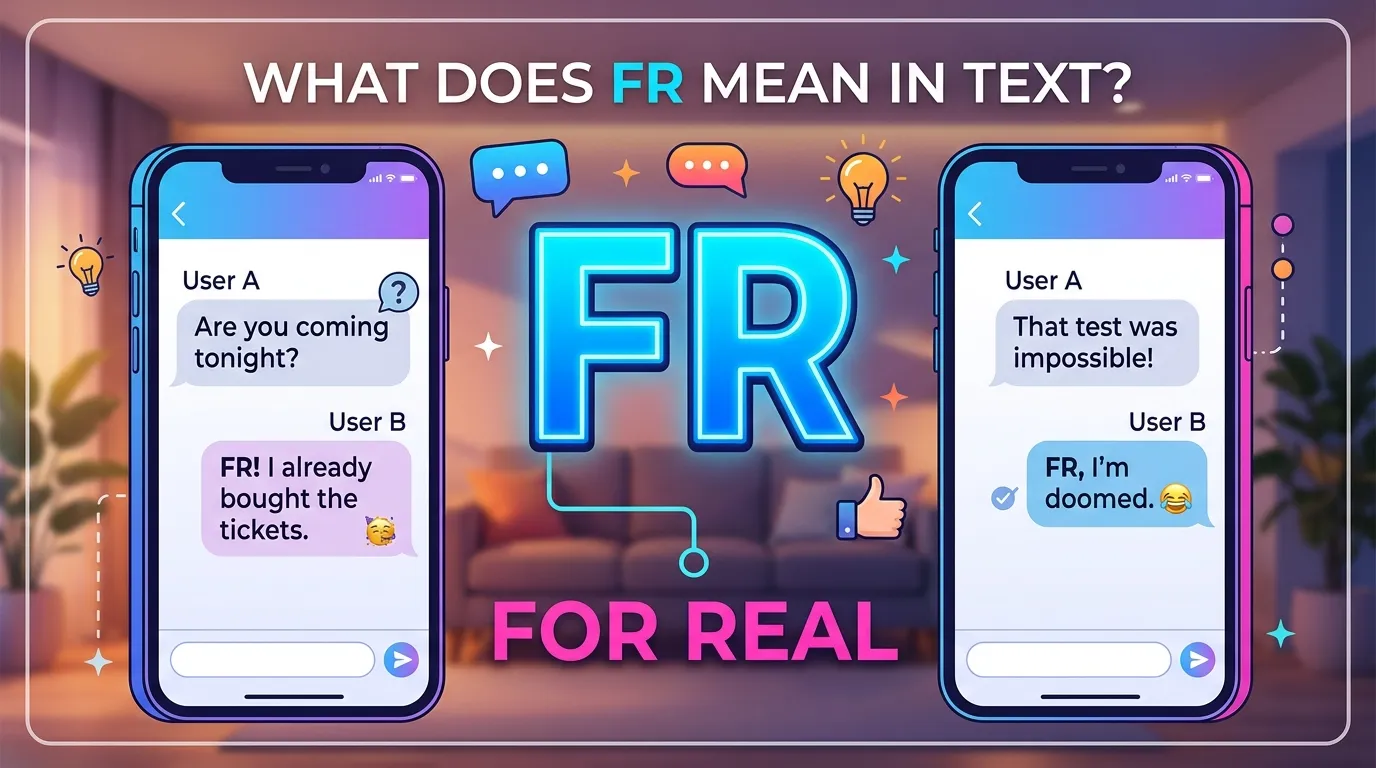
Now you know exactly what FR mean in text and how people use it across different platforms every day. Whether someone says “FR though” in a comment or drops “no cap FR” in a DM, the meaning is clear once you understand texting slang.
FR mean in text simply stands for For Real used to express agreement, surprise, or strong emotion in casual digital conversations. It is one of the most widely used abbreviations on TikTok, Instagram, Snapchat, Twitter, and WhatsApp today.
Understanding these short abbreviations helps you communicate faster, sound more natural online, and connect better with younger audiences on social media.
Bookmark this guide so you never feel lost reading a text again. If this helped you, share it with friends who also wonder what popular slang terms mean. Stay updated with more texting slang guides and level up your digital communication skills today.
What FR Mean in Text Meaning
FR is a popular internet abbreviation that means “For Real.”
It is considered slang and also works as an abbreviation because it shortens a common phrase into just two letters. Instead of typing “for real,” people simply write FR to save time while texting.
The phrase is often used to show honesty, agreement, excitement, or disbelief. It adds emphasis to a message without making it longer.
Here are a few simple examples:
- I’m so tired today, FR.
- That movie was amazing, FR!
- FR, I didn’t expect that to happen.
- You finished the whole project today? FR?
In each example, FR helps strengthen the speaker’s feelings.
Different Ways FR Is Used
Although “For Real” is the main meaning, people use FR in slightly different ways depending on the conversation.
To Show Agreement
Many people use FR when they completely agree with someone.
Example:
A: This weather is perfect.
B: FR. I wish every day was like this.
To Show Honesty
Someone may use FR to let others know they are telling the truth.
Example:
“I saw the celebrity downtown, FR.”
To Express Surprise
FR can also be used as a question when someone finds something hard to believe.
Example:
“FR? You won the competition?”
To Add Emphasis
Sometimes FR simply makes a sentence sound stronger.
Example:
“That pizza was good, FR.”
Where People Use FR
FR appears almost everywhere online. Since it is short and easy to type, it has become one of the most common internet abbreviations.
TikTok
On TikTok, people often write FR in comments and captions to agree with a video or react to something funny.
Examples include:
- “FR this deserves more likes.”
- “You’re speaking facts, FR.”
Creators also use it in captions to make their opinions sound stronger.
Snapchat
Snapchat conversations are usually fast and casual, making FR a common choice.
Friends might send messages like:
- “FR, that filter looks awesome.”
- “You skipped class? FR?”
Because Snapchat messages disappear, users often rely on short slang like FR.
On Instagram, you’ll find FR in comments, Stories, Reels, and direct messages.
Someone may comment:
- “FR, this photo is beautiful.”
- “You’re talented, FR.”
It helps people show genuine appreciation or agreement without writing long comments.
WhatsApp chats between friends often include FR during everyday conversations.
For example:
- “I’m hungry, FR.”
- “FR, we should plan a trip.”
The abbreviation keeps conversations quick while still sounding natural.
SMS (Text Messages)
Even in regular phone texting, FR is very common.
Instead of typing “for real,” people simply write FR.
Example:
Friend: I’m moving next month.
You: FR? That’s exciting!
Whether you’re chatting with close friends or classmates, FR makes texting faster and more conversational.
Real Chat Examples
Below are realistic conversations that show how FR is used in everyday texting.
Example 1
A: That new restaurant is amazing.
B: FR?
A: Yes, you should definitely try it.
Example 2
A: I finished the entire series in one weekend.
B: FR? That’s impressive.
A: I couldn’t stop watching.
Example 3
A: We don’t have homework today.
B: FR?
A: The teacher announced it before class ended.
Example 4
A: This game is addictive.
B: FR. I’ve been playing it every evening.
A: Same here.
Example 5
A: I met my favorite singer yesterday.
B: FR?
A: Yes, I even took a picture.
Example 6
A: The traffic was terrible today.
B: FR. It took me almost two hours to get home.
A: Mine was just as bad.
Example 7
A: Your presentation was excellent.
B: FR? Thanks, I was nervous.
A: You did great.
Example 8
A: This phone battery lasts forever.
B: FR. Mine still has 60% left.
A: Same experience here.
Example 9
A: We should order pizza tonight.
B: FR. I’ve been craving pizza all day.
A: Let’s do it.
Example 10
A: I can’t believe it’s already Friday.
B: FR. This week went by so fast.
A: Time really flies.
How to Reply When Someone Says “FR”
The best reply depends on the conversation. Sometimes the person is agreeing with you, while other times they’re asking if you’re serious.
Funny Replies
If you’re joking with friends, these responses can fit naturally.
- Absolutely, no fake news here.
- One hundred percent.
- You know I’m telling the truth.
- I’m serious this time.
- I wouldn’t make this up.
Casual Replies
These are perfect for everyday texting.
- Yep.
- For sure.
- Definitely.
- That’s right.
- Exactly.
Friendly Replies
These replies keep the conversation warm and relaxed.
- I know, right?
- I’m glad you agree.
- Thanks!
- That’s what I thought too.
- Happy you feel the same way.
Neutral Replies
If someone asks “FR?” because they’re surprised, these responses work well.
- Yes, it’s true.
- I’m being serious.
- That’s correct.
- It really happened.
- No joke.
Using the right reply depends on the tone of the conversation. With friends, casual responses are usually enough, while more neutral replies are better when you’re talking to classmates, coworkers, or people you don’t know well.
Is FR Rude or Offensive?
No. FR is generally not considered rude or offensive. It is one of the most common internet abbreviations and is widely accepted in casual online conversations.
Most people use FR to show agreement, emphasize a point, or confirm that they are being honest. On platforms like TikTok, Snapchat, Instagram, and WhatsApp, it is viewed as friendly and informal rather than disrespectful.
However, because FR is internet slang, it may not be suitable for every situation. In professional emails, job applications, business communication, or formal school assignments, writing out “for real”—or choosing more formal wording—is usually a better choice.
When chatting with friends, classmates, or family members, using FR is perfectly normal. In formal settings, it’s best to avoid abbreviations and communicate more professionally.
Who Uses This Term?
FR is one of the most common internet abbreviations today. While almost anyone can use it, it is especially popular among younger people who spend a lot of time on social media and messaging apps.
Gen Z
Gen Z uses FR more than any other age group. Teenagers and young adults often include it in conversations to show agreement or emphasize that they are being serious.
You’ll frequently see comments like:
- “FR, this is the best song of the year.”
- “You’re so right, FR.”
Because Gen Z prefers quick and casual communication, abbreviations like FR have become part of everyday online language.
Millennials
Many Millennials also use FR, especially when texting friends or commenting on social media posts.
Although some Millennials prefer writing “for real” in full, many still use the shorter version because it’s faster and widely understood.
Teenagers
High school and college students commonly use FR in group chats, gaming communities, and social media conversations.
It’s often paired with other internet slang such as:
- LOL
- OMG
- IDK
- NGL
- TBH
Social Media Users
Anyone active on social media has probably seen FR before. It regularly appears in:
- TikTok comments
- Instagram captions
- Snapchat chats
- WhatsApp conversations
- Facebook Messenger
- X (formerly Twitter)
- Discord servers
Because it is short and easy to understand, FR continues to grow in popularity across different online communities.
How Common Is FR?
FR is now considered a mainstream internet abbreviation.
If you spend time reading comments, watching short videos, or chatting online, you’ll likely come across it almost every day.
Its popularity comes from its simplicity. Two letters are enough to express agreement, honesty, or surprise, making conversations faster without changing their meaning.
Origin of the Term
The abbreviation FR comes directly from the phrase “For Real.”
People have used the expression “for real” in spoken English for many years to emphasize that something is true or genuine.
As text messaging became more popular in the late 1990s and early 2000s, users began shortening common phrases to save time and reduce typing.
That’s when “For Real” gradually became FR.
Growth Through Internet Culture
The rise of smartphones, instant messaging, and social media helped FR spread quickly.
Platforms such as:
- Snapchat
- TikTok
- Twitter (now X)
made short abbreviations even more popular because users wanted faster ways to communicate.
Instead of typing:
“I completely agree with you.”
People simply wrote:
“FR.”
The meaning stayed the same while requiring much less effort.
Is the Exact Origin Known?
There isn’t one person who invented FR.
Like many internet slang terms, it developed naturally as online communication evolved.
Its popularity grew through texting culture, online forums, gaming communities, and eventually social media platforms where millions of users adopted it.
Today, FR is recognized by internet users around the world and has become part of everyday digital communication.
Comparison Table
| Abbreviation | Meaning | Type | Usage | Popularity |
| FR | For Real | Slang / Abbreviation | Showing agreement, honesty, or emphasis | Very High |
| IDK | I Don’t Know | Acronym | Expressing uncertainty | Very High |
| IDC | I Don’t Care | Acronym | Showing lack of interest | High |
| IMO | In My Opinion | Acronym | Sharing personal opinions | High |
| BRB | Be Right Back | Acronym | Leaving a conversation briefly | High |
Although all of these abbreviations are common, they serve different purposes. FR is unique because it often expresses emotion, sincerity, or strong agreement instead of providing information.
Real-World Usage Example
Imagine two friends chatting after watching a popular movie that everyone has been talking about online.
Alex: That ending was completely unexpected.
Jordan: FR! I never saw that coming.
Alex: Same here. It was probably the best part of the movie.
In this conversation, Jordan uses FR to show complete agreement with Alex’s opinion. Instead of writing a longer response like “I completely agree,” the abbreviation keeps the conversation short, natural, and friendly.
You might also hear people use FR during school breaks, while gaming with friends, or when discussing trending TikTok videos. Its flexibility makes it useful in many everyday situations where casual language is appropriate.
FAQs:
What does FR mean in text messages?
In text messages, FR usually means “For Real.” It is used to show honesty, agreement, or emphasize that someone is being serious.
What does FR mean on TikTok?
On TikTok, FR often appears in comments, captions, and replies. People use it to agree with a video, react to something surprising, or express that they genuinely mean what they’re saying.
Is FR slang?
Yes. FR is considered internet slang as well as a common abbreviation used in casual online conversations.
Is FR rude or offensive?
No. FR is generally not rude or offensive. It is safe to use with friends and in informal conversations. However, it’s best to avoid slang in professional emails, business communication, or formal school assignments.
How should you reply to FR?
Your reply depends on the context. If someone is agreeing with you, you can respond with:
- “Exactly!”
- “I know, right?”
- “Glad you agree.”
If someone asks “FR?” because they’re surprised, you can simply reply:
- “Yes, it’s true.”
- “I’m serious.”
- “No joke.”
Conclusion:
FR is a simple abbreviation for “For Real,” and it’s one of the most widely used expressions in modern online conversations. Whether someone is agreeing with a statement, emphasizing that they’re telling the truth, or reacting with surprise, FR helps keep messages short and natural.
You’ll commonly find it on TikTok, Snapchat, Instagram, WhatsApp, and in everyday text messages. Because it’s easy to understand and quick to type, people of all ages especially Gen Z use it regularly.
Although FR is perfectly acceptable in casual conversations with friends and family, it’s usually better to avoid internet slang in professional or formal situations. Understanding when and where to use it will help you communicate more confidently online and keep up with today’s digital language.

Sarah Whitfield is a Bible researcher and writer at askmeanings.com She explains biblical meanings in a simple and easy-to-understand way.