What does SM mean in text? If you’ve seen this short abbreviation in a message or social media post and felt confused, you’re not alone. Millions of people search this question every day.
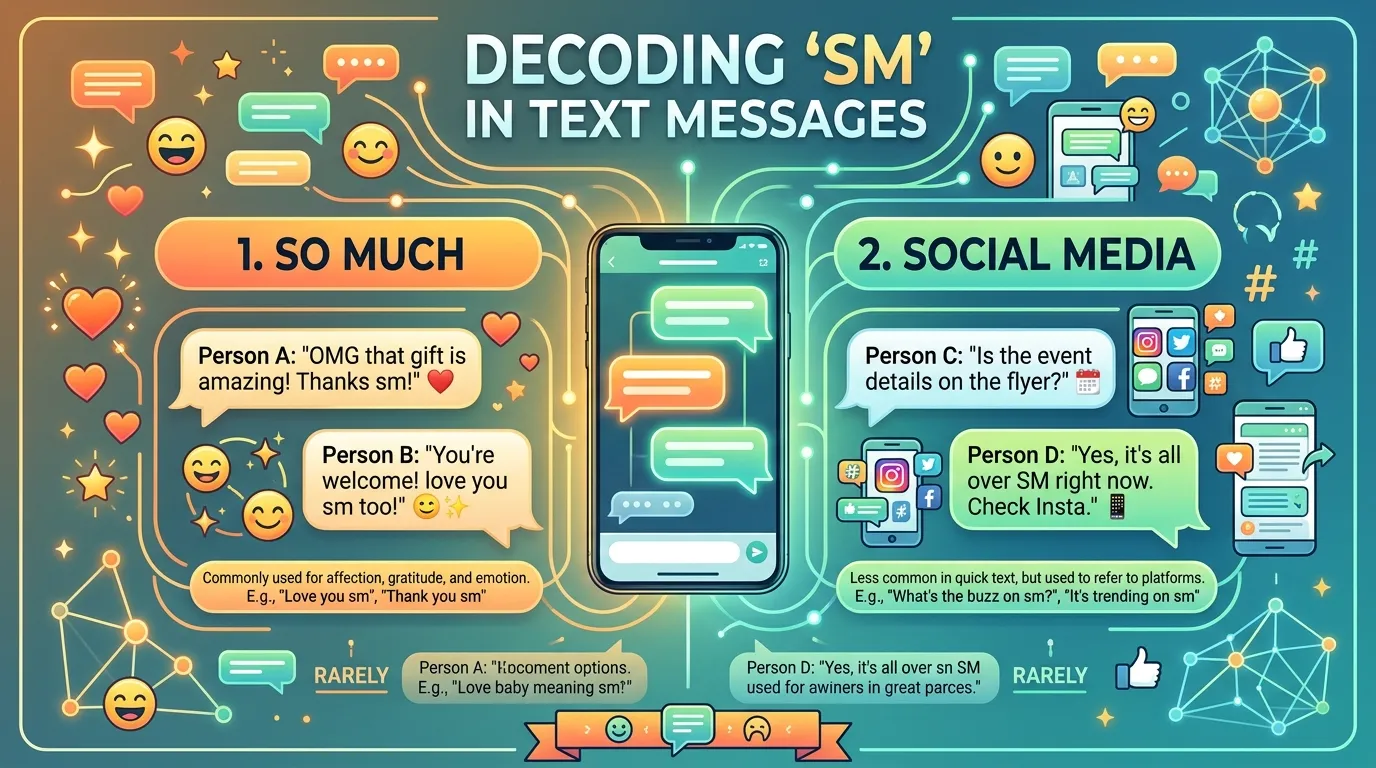
SM is one of the most commonly used abbreviations in modern texting and online conversations. It typically stands for “so much” as in “I love you SM” but depending on the context, it can also refer to social media or other meanings.
Understanding what SM means in text helps you communicate better, avoid misunderstandings, and stay updated with digital language trends.
Whether you’re a teenager, a parent, or a professional navigating social platforms, knowing popular text abbreviations like SM is essential in today’s fast-moving digital world.
In this guide, you’ll discover the real meaning of SM, see real-life examples, and learn exactly how and where it’s used online.
SM Meaning in Text
The abbreviation SM most commonly stands for “so much.” It’s a simple way to shorten a phrase that people use frequently in everyday conversations.
Instead of typing the full words, many people write SM to save time, especially when chatting on their phones. Since texting is meant to be quick and casual, abbreviations like this have become part of everyday online communication.
For example, someone might write:
- I miss you SM.
- Thanks SM.
- I appreciate you SM.
- I love this song SM.
- This made me laugh.
In each of these examples, SM simply replaces the words “so much.” The message still has the same meaning but takes fewer keystrokes to type.
Is SM an Acronym, Slang, or Abbreviation?
SM is generally considered an abbreviation rather than a traditional acronym.
An acronym usually forms a new word that people pronounce as a word, while an abbreviation simply shortens an existing phrase using its first letters.
Because SM represents the phrase “so much,” it’s more accurate to call it an abbreviation that’s widely used in internet slang.
Like many texting shortcuts, it became popular because people wanted faster ways to communicate on mobile devices and social media platforms.
What Does SM Mean in Everyday Chat?
In daily conversations, SM usually adds emphasis to what someone is saying.
For instance:
“Thank you SM.”
This means:
“Thank you so much.”
Or:
“I miss you SM.”
Which simply means:
“I miss you so much.”
People also use it when talking about things they enjoy.
Examples include:
- I love this movie SM.
- I like your new haircut SM.
- That concert was fun SM.
- This food is good SM.
Although the abbreviation is short, it expresses strong emotions such as gratitude, excitement, happiness, affection, or appreciation.
Does SM Always Mean “So Much”?
Not always.
While “so much” is by far the most common meaning in text messages and social media conversations, SM can occasionally stand for something different depending on the context.
For example:
- Social Media
- Small
- Service Mark (in business or legal discussions)
- Sado-Masochism (used only in specific adult or psychological contexts)
However, in everyday texting between friends, family, classmates, or coworkers, SM almost always means “so much.”
The surrounding conversation usually makes the meaning obvious.
For example:
“I love this song SM.”
There’s little chance someone would misunderstand this as “social media” or another meaning. Context helps readers interpret abbreviations correctly.
Why Do People Use SM Instead of Writing “So Much”?
There are several reasons why people prefer using abbreviations like SM.
First, it saves time when typing on a phone.
Second, it keeps conversations short and casual.
Third, many people naturally imitate the texting style they see on social media platforms.
Today’s online communication is full of abbreviations such as:
- LOL
- BRB
- IDK
- IMO
- TBH
- SM
Using these expressions helps conversations feel quick, relaxed, and natural.
That said, it’s usually better to write the complete phrase “so much” in professional emails, school assignments, or formal workplace communication.
Common Sentences Using SM
Here are a few examples of how people naturally use SM in everyday conversations:
- Thanks SM for your help today.
- I miss my best friend SM.
- I enjoyed that movie SM.
- You’re helping me SM.
- I appreciate it, SM.
- Love this outfit SM.
- I laughed at SM after reading your message.
- I needed this SM today.
Notice how the abbreviation fits naturally at the end of a sentence. This is the most common way people use it online.
Where People Use SM
SM appears across almost every major messaging app and social media platform. While the meaning stays mostly the same, the way people use it can vary slightly depending on where they’re chatting.
Let’s look at the most common places you’ll see this abbreviation.
TikTok
TikTok is one of the biggest reasons internet slang spreads so quickly.
People leave millions of comments every day, and short abbreviations help them react faster. Instead of writing long sentences, users often keep their comments brief.
You might see comments like:
- I love this SM.
- This dance is amazing SM.
- I’ve watched this video SM.
- This made me smile.
- You’re so talented SM.
Creators also use SM in captions when thanking followers or expressing excitement.
For example:
Thanks SM for 100K followers!
Because TikTok focuses on fast engagement, abbreviations like SM fit naturally into comments and captions.
Snapchat
Snapchat conversations are usually private, casual, and fast-moving. Friends often send short messages throughout the day, making abbreviations extremely common.
Examples include:
- Miss you SM.
- Thanks SM for yesterday.
- You’re funny SM.
- I appreciate you SM.
- Love your snap SM.
Since Snapchat messages often disappear after being viewed, users generally don’t worry about perfect grammar or complete sentences. Short forms like SM make conversations quicker and feel more natural.
Instagram users frequently use SM in comments, direct messages, Stories, and captions.
For example, someone commenting on a vacation photo might write:
- I love this place SM.
- Your outfit looks amazing SM.
- This picture is a beautiful SM.
- Miss seeing you SM.
Influencers and creators may also use the abbreviation when thanking their audience.
Example:
Thanks SM for all your support.
Because Instagram encourages social interaction, abbreviations help keep conversations friendly and engaging.
WhatsApp is one of the most popular messaging apps worldwide, and people of all ages use it every day.
Friends, siblings, classmates, and even family members often include SM in their chats.
Some common examples are:
- Thanks SM.
- I appreciate you SM.
- Miss you SM.
- Love you SM.
- That helped SM.
Although WhatsApp supports longer messages, many users still prefer abbreviations because they’re quick and familiar.
SMS (Text Messages)
Even with the rise of social media apps, traditional text messaging remains popular.
Many people continue using abbreviations they learned years ago, including SM.
A few examples include:
- Thanks SM for picking me up.
- I missed talking to you SM.
- I enjoyed today’s SM.
- Love you SM.
Unlike formal emails, SMS conversations are usually informal. That’s why abbreviations such as SM feel perfectly natural in everyday texting.
Why You See SM So Often Online
The popularity of SM comes down to one simple reason—it’s fast.
Modern online conversations happen quickly. Whether someone is commenting on a TikTok video, replying to an Instagram Story, or sending a WhatsApp message, abbreviations help them communicate with fewer words while keeping the same meaning.
As internet culture continues to evolve, short expressions like SM remain a common part of digital communication. Even people who don’t use the abbreviation regularly will often recognize its meaning because it’s become so widespread across social media and messaging apps.
Real Chat Examples
Understanding an abbreviation is much easier when you see it used in real conversations. Below are ten realistic texting examples that show how SM naturally fits into everyday chats. In every example, SM means “so much.”
Example 1
A: Thanks for helping me finish my project.
B: Anytime! I’m glad I could help.
A: I appreciate it SM.
Example 2
A: Did you enjoy the concert?
B: Yes! It was amazing.
A: I loved it SM. We should go again.
Example 3
A: Happy Birthday!
B: Thank you!
A: Hope you have the best day SM.
Example 4
A: I finally passed my driving test.
B: Congratulations!
A: Thanks SM. I was really nervous.
Example 5
A: Have you watched the new movie yet?
B: Yes, last night.
A: I liked it, SM. The ending surprised me.
Example 6
A: Sorry I couldn’t come today.
B: No worries.
A: Thanks SM for understanding.
Example 7
A: This restaurant is incredible.
B: I told you!
A: You’re right. I love the food SM.
Example 8
A: I miss our school days.
B: Same here.
A: I miss everyone SM.
Example 9
A: Your advice really helped me.
B: I’m happy to hear that.
A: Thanks SM. It meant a lot.
Example 10
A: How was your vacation?
B: It was fantastic!
A: I’m jealous, SM. The pictures looked amazing.
These examples show that SM is usually placed at the end of a sentence to emphasize gratitude, excitement, affection, or appreciation. Native English speakers use it naturally in casual online conversations, especially with friends and family.
How to Reply When Someone Says “SM”
If someone sends you a message with SM, your reply should match the tone of the conversation. Since the abbreviation usually means “so much,” it’s often part of a positive or appreciative message.
Here are some natural ways to respond.
Funny Replies
If you’re chatting with close friends, a lighthearted response can keep the conversation fun.
Examples:
- You’re making me blush.
- Don’t make me emotional now.
- You’re too kind.
- I deserve a trophy now.
- That’s the nicest thing I’ve heard today.
Funny replies work best with people you know well and who understand your sense of humor.
Casual Replies
Most everyday conversations only need a simple response.
Examples:
- Anytime!
- No problem.
- Of course.
- You’re welcome.
- Glad I could help.
- Happy to hear that.
These replies sound natural and fit almost any casual conversation.
Friendly Replies
When someone expresses appreciation or affection, you can reply warmly.
Examples:
- That means a lot.
- I appreciate you too.
- You’re always welcome.
- I’m happy to help.
- You’re the best.
- Thank you!
Friendly replies help keep the conversation positive without sounding overly formal.
Neutral Replies
Sometimes a simple response is all that’s needed.
Examples:
- Thanks.
- Sounds good.
- I understand.
- That’s nice to hear.
- Okay.
- I appreciate it.
Neutral replies are useful when you’re texting classmates, coworkers, or people you don’t know very well.
Should You Reply Using SM Too?
Yes, you can.
For example:
A: Thanks SM.
B: You’re welcome! Happy to help.
Or:
A: Miss you SM.
B: Miss you too!
There’s no rule saying you must use the abbreviation yourself. Writing the full phrase “so much” is equally acceptable and often feels a little more personal.
Is SM Rude or Offensive?
One of the most common questions people ask is whether SM is considered rude.
The answer is no.
In its most common meaning, SM (“so much”) is a friendly and harmless abbreviation. It doesn’t contain offensive language or negative meaning.
People usually use it to show appreciation, excitement, gratitude, affection, or strong emotions.
For example:
- Thanks SM.
- Love you SM.
- Miss you SM.
- I appreciate it, SM.
All of these are positive expressions.
Is It Safe to Use?
Yes.
SM is considered safe for everyday conversations with:
- Friends
- Family
- Classmates
- Neighbors
- Online communities
- Social media followers
Most English speakers will immediately understand what you mean if the context is clear.
Is It Appropriate at School?
Generally, yes—but only in informal conversations.
If you’re texting classmates or chatting in a school group chat, using SM is perfectly normal.
However, if you’re writing:
- an essay,
- a research paper,
- a formal email to a teacher, or
- an academic assignment,
it’s better to write “so much” instead of the abbreviation.
Formal writing should avoid unnecessary texting shortcuts.
Is It Appropriate at Work?
That depends on the situation.
If you’re messaging a close coworker through an internal chat app, writing:
Thanks SM.
may be perfectly acceptable.
However, in professional emails, client communication, business reports, or official documents, it’s better to avoid abbreviations like SM.
Instead, write:
Thank you so much.
It sounds more professional and leaves no room for misunderstanding.
Can SM Be Misunderstood?
Occasionally, yes.
Although “so much” is the most common meaning, SM has other meanings in different fields.
For example, it can refer to:
- Social Media
- Service Mark
- Small
Because of these alternative meanings, context is important.
If someone writes:
I love this SM.
Most readers immediately understand they mean:
I love this so much.
But in a business article discussing branding, SM could represent a completely different term.
Reading the entire sentence helps avoid confusion.
Who Uses This Term?
The abbreviation SM is widely used across the internet, but it’s especially common among younger generations who communicate online every day.
Gen Z
Gen Z is one of the biggest users of texting abbreviations.
Because they spend a lot of time on platforms like TikTok, Snapchat, Instagram, and Discord, they often shorten common phrases to make conversations faster.
SM fits naturally into that style of communication.
Teenagers
Teenagers frequently use SM while chatting with friends.
You’ll often see messages like:
- Miss you SM.
- Love this SM.
- Thanks SM.
For many teens, abbreviations are simply part of everyday texting.
Millennials
Millennials also recognize and use SM, although many switch between abbreviations and full words depending on who they’re talking to.
For example, they might text a friend:
Thanks SM!
But write in a work email:
Thank you so much for your assistance.
Adults
Adults who regularly use social media generally understand SM, even if they don’t use it often themselves.
Because internet slang has become so widespread, many abbreviations have crossed generational boundaries.
Where Is SM Most Common?
Today, you’ll most often see SM on:
- TikTok
- Snapchat
- Facebook Messenger
- Discord
- SMS text messages
- Online gaming chats
The abbreviation has become part of everyday internet language and continues to appear in millions of conversations each day.
Origin of the Term
Unlike some internet slang that can be traced to a specific website or community, the exact origin of SM isn’t fully documented.
Most language experts believe it developed naturally during the early years of online messaging.
In the late 1990s and early 2000s, text messages had strict character limits, and typing on mobile phones required much more effort than it does today. To save time and space, users began shortening common words and phrases.
Expressions like LOL, BRB, IDK, IMO, and SM became part of everyday digital communication.
As smartphones and social media platforms grew in popularity, these abbreviations spread even faster. Today, millions of people recognize SM without needing an explanation because it’s become a familiar part of internet culture.
Although there’s no confirmed inventor of the abbreviation, its continued use reflects how online language evolves. People naturally create shorter, faster ways to communicate, and when enough users adopt them, they become part of everyday texting vocabulary.
Comparison Table
Many texting abbreviations look similar, but they have completely different meanings. The table below compares SM with some of the most common internet abbreviations you’ll see in text messages and on social media.
| Abbreviation | Meaning | Type | Common Usage | Popularity |
| SM | So Much | Abbreviation | Expresses appreciation, affection, or emphasis | High |
| IDK | I Don’t Know | Acronym | Used when someone doesn’t know the answer | Very High |
| IDC | I Don’t Care | Acronym | Shows a lack of interest or concern | High |
| IMO | In My Opinion | Acronym | Used before sharing a personal opinion | High |
| BRB | Be Right Back | Acronym | Lets someone know you’ll return shortly | Very High |
Although these abbreviations are common, each serves a different purpose. SM focuses on expressing stronger emotions, while abbreviations like IDK or BRB are mainly used to make conversations shorter and faster.
If you’re new to internet slang, learning these common abbreviations will make it much easier to understand text messages, social media comments, and online conversations.
Real-World Usage Example
Imagine you’re working on a school project with a friend. They spend several hours helping you finish your presentation before the deadline.
After you get home, you send them a message that says:
“Thanks SM for helping me today. I couldn’t have finished it without you.”
Here, SM simply means “so much.” It shows sincere appreciation while keeping the message short and casual.
Here’s another example.
Your favorite singer releases a brand-new song, and you leave a comment on Instagram:
“I love this song SM!”
Anyone reading the comment will immediately understand that you’re saying you love the song so much.
Or imagine you’re chatting with your best friend after they move to another city.
You text:
“Miss you SM. We need to meet soon.”
Again, the abbreviation adds emotion without making the message longer.
These examples show why SM has become popular. It’s quick to type, easy to understand, and works naturally in everyday conversations.
FAQs:
What does SM mean in text messages?
In most text messages, SM means “so much.” People use it to express appreciation, affection, excitement, or strong feelings in a shorter way.
What does SM mean on TikTok?
On TikTok, SM almost always means “so much.” You’ll often see comments like:
- Love this SM.
- Miss this trend SM.
- I laughed at SM.
It’s commonly used in comments, captions, and replies.
Is SM slang?
Yes. SM is considered part of modern internet slang, although it’s technically an abbreviation rather than a traditional acronym. It’s widely used in casual online conversations.
Is SM rude or offensive?
No.
The abbreviation SM is not rude, offensive, or inappropriate in its common meaning. It’s simply a shorter way of saying “so much.”
However, because it’s informal, it’s best to avoid using it in business emails, academic writing, or professional communication.
How should you reply to SM?
Your reply depends on the conversation.
If someone says:
“Thanks SM.”
You could reply:
- You’re welcome!
- Anytime!
- Happy to help.
- Of course!
- No problem.
If someone says:
“Miss you SM.”
You might reply:
- Miss you too!
- Can’t wait to see you.
- Same here!
- We should meet soon.
Keeping your response natural and friendly is usually the best approach.
Final Thoughts:
The abbreviation SM most commonly means “so much” in text messages and online conversations. It’s a simple expression that helps people communicate quickly while still showing appreciation, affection, excitement, or gratitude.
You’ll regularly see SM used on TikTok, Snapchat, Instagram, WhatsApp, Facebook Messenger, Discord, and traditional SMS text messages. Because it’s short and easy to type, it has become part of everyday internet language.
Although SM is perfectly acceptable in casual conversations, it’s usually better to write the complete phrase “so much” when sending professional emails, writing academic papers, or communicating in formal situations.
As with most internet abbreviations, context is the key. If someone writes, “I miss you SM” or “Thanks SM,” they’re almost certainly using it to mean “so much.”
The more familiar you become with common texting abbreviations, the easier it will be to understand online conversations and communicate confidently across different social media platforms.