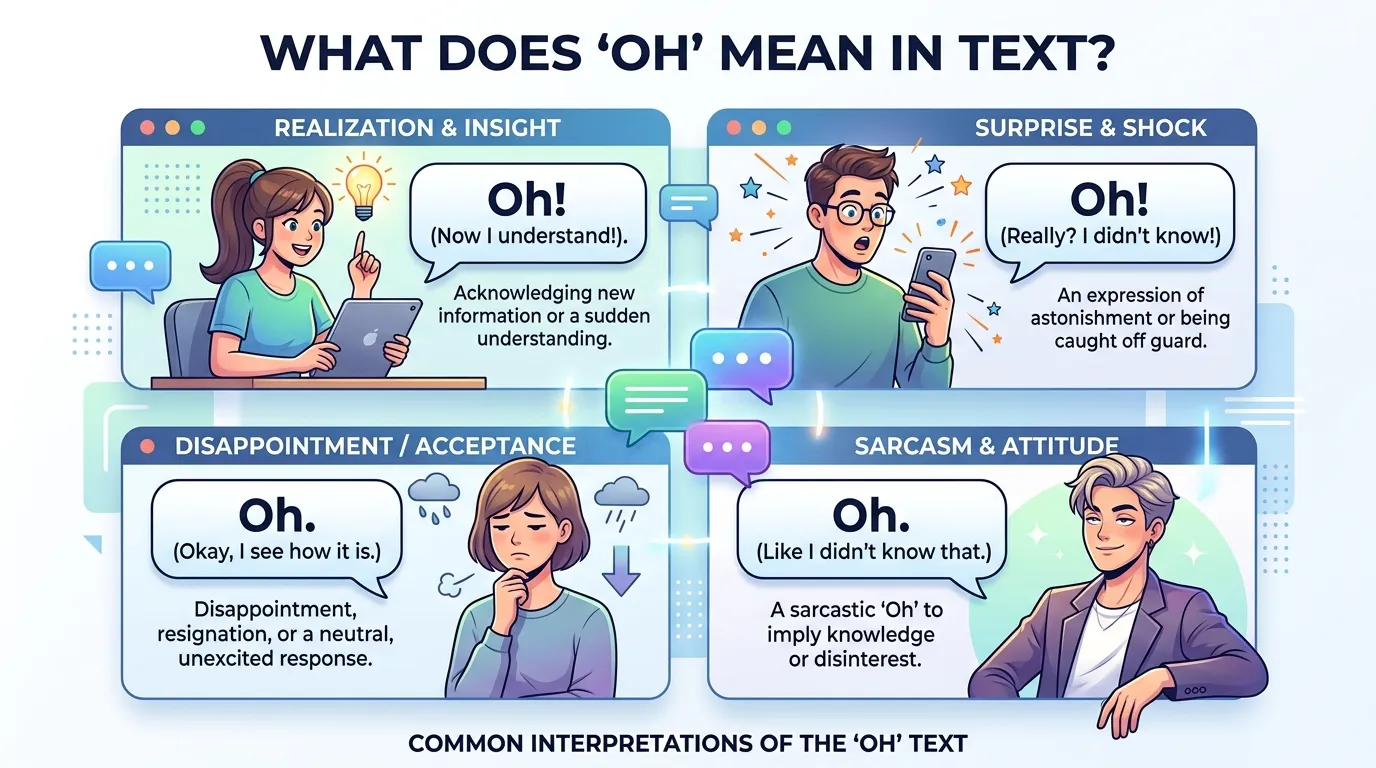
Have you ever received a message with just “oh” and wondered what it really means? You’re not alone. Understanding what does oh mean in text is more important than ever in today’s digital communication world.
The word “oh” seems simple, but its meaning completely changes depending on the context, tone, and conversation. It can express surprise, disappointment, understanding, sarcasm, or even emotional distance — all in just two letters.
Whether someone sends you “oh okay,” “oh really,” or simply “oh,” each carries a different emotional signal. This tiny word holds big meaning in texting, WhatsApp, Instagram DMs, and other social media platforms.
In this guide, you will learn the real meaning of “oh” in text, see real-life examples, and understand exactly how people use it online. By the end, you’ll never misread an “oh” again.
What Does “Oh” Mean in Text?
In texting, “oh” is an interjection, which is a word people use to express an immediate feeling or reaction. It isn’t an acronym, internet slang, or abbreviation. Instead, it’s a natural part of everyday English that has become one of the most common expressions in online conversations.
People use “oh” when they receive new information, realize something, or react emotionally to a message. Since text messages don’t include voice tone or facial expressions, the meaning of “oh” changes based on the surrounding conversation.
For example, if someone texts:
Friend: I finally got the job!
A simple reply like:
You: Oh, that’s awesome! Congratulations!
shows surprise and happiness.
Now imagine a different conversation:
Friend: The event was canceled.
You: Oh, okay.
Here, “oh” simply means you’ve understood the information.
This flexibility is why “oh” appears in millions of conversations every day. It helps people respond naturally without needing long explanations.
Is “Oh” Slang, an Acronym, or an Abbreviation?
One of the biggest misconceptions is that “oh” is internet slang. In reality, it isn’t.
Here’s what “oh” actually is:
- Not an acronym: It doesn’t stand for any words.
- Not an abbreviation: It isn’t a shortened version of another word.
- Not modern internet slang: People have been saying and writing “oh” for centuries.
- An interjection: A word used to express emotion, realization, or reaction.
Unlike terms such as IDK, IMO, or BRB, “oh” has always been part of the English language. Social media didn’t create it, it simply became even more common through texting and online messaging.
Because it’s so short and versatile, people naturally use it as one of the quickest ways to react during conversations.
Different Meanings of “Oh” in Conversations
The meaning of “oh” changes depending on the context. Understanding the conversation is much more important than looking at the word by itself.
Below are the most common ways people use it.
1. Surprise
This is one of the most frequent meanings.
Example
A: I won the lottery.
B: Oh! That’s incredible.
The speaker is expressing genuine surprise.
2. Realization
Sometimes “oh” means someone has suddenly understood something.
Example
A: That’s why the store was closed yesterday.
B: Oh, now I get it.
In this case, “oh” signals a moment of understanding.
3. Understanding
People often use “oh” to acknowledge information without adding much else.
Example
A: I’ll be about twenty minutes late.
B: Oh, okay.
This simply means, “I understand.”
4. Disappointment
Depending on the wording, “oh” can show disappointment.
Example
A: We couldn’t get concert tickets.
B: Oh, that’s too bad.
Here, the speaker is reacting sympathetically.
5. Excitement
People also use “oh” before expressing happiness.
Example
A: Guess what? We’re going to Disney World!
B: Oh, that’s amazing!
The reaction feels natural and enthusiastic.
6. Curiosity
Sometimes “oh?” with a question mark means the person wants to hear more.
Example
A: I have something important to tell you.
B: Oh? What happened?
The question mark changes “oh” into an invitation to continue the story.
7. Sympathy
If someone shares bad news, “oh” can express care and concern.
Example
A: My dog isn’t feeling well.
B: Oh, I’m sorry to hear that.
This response shows empathy rather than surprise.
8. Mild Confusion
Occasionally, “oh” means the person is still processing information.
Example
A: We have to change all our plans.
B: Oh… why?
The pause suggests uncertainty or confusion.
Why Does “Oh” Mean So Many Different Things?
Unlike many internet abbreviations that have one fixed meaning, “oh” reflects emotion.
Think of it as the written version of a facial expression. When people speak, their voice naturally tells you whether they’re excited, confused, disappointed, or happy.
In text messages, readers don’t hear that tone. Instead, they rely on punctuation, emojis, and the rest of the conversation to understand what “oh” means.
For example:
- Oh! often sounds excited.
- Oh… may sound disappointed or uncertain.
- Oh? usually expresses curiosity.
- Oh, okay. often means understanding.
- Oh wow! expresses surprise and excitement.
The surrounding words are what give “oh” its true meaning.
Where People Use “Oh”
You’ll find “oh” almost everywhere people communicate online. Although each platform has its own style, the basic meaning remains the same.
TikTok
TikTok users frequently comment “oh” when reacting to surprising videos, unexpected endings, or emotional stories.
Examples include:
- “Oh wow, I didn’t see that coming.”
- “Oh, that’s actually true.”
- “Oh no!”
Because TikTok content is designed to capture attention quickly, short reactions like “oh” are extremely common in comment sections.
Snapchat
Snapchat conversations are usually casual and fast-paced. Friends often reply with simple reactions instead of long messages.
Examples:
- Oh lol.
- Oh really?
- Oh okay.
- Oh nice.
These quick responses help keep conversations flowing naturally.
On Instagram, people use “oh” in comments, direct messages, and story replies.
Someone might reply:
- Oh, I love this picture.
- Oh, congratulations!
- Oh, that’s beautiful.
- Oh no, hope you’re okay.
Because Instagram is highly visual, “oh” often appears as an immediate emotional reaction to photos, videos, or announcements.
WhatsApp is one of the most popular messaging apps worldwide, making “oh” a common everyday response.
People use it while chatting with family, friends, classmates, and coworkers.
Examples include:
- Oh, thanks.
- Oh, I’ll call you later.
- Oh, I didn’t know that.
- Oh, sounds good.
These short acknowledgments make conversations feel friendly and natural.
SMS Text Messages
Traditional text messaging uses “oh” in exactly the same way.
Whether someone is making weekend plans, sharing good news, or discussing work, “oh” remains one of the simplest ways to react before continuing the conversation.
Its versatility is one reason it has stayed popular for generations, even as new social media platforms continue to emerge.
Why Is “Oh” So Common Online?
The biggest reason is simplicity.
Typing “oh” takes only a second, yet it immediately tells the other person you’ve read and reacted to their message. From there, you can continue the conversation naturally.
Unlike many internet abbreviations that come and go, “oh” has remained a timeless part of English communication. Whether you’re chatting with friends on Snapchat, commenting on TikTok, or messaging family on WhatsApp, it’s one of the easiest and most natural ways to respond.
In the next section, we’ll look at real text conversations, show 10 realistic chat examples, explain how to reply when someone says “oh,” and discuss whether the word can ever sound rude or offensive.
Real Chat Examples of “Oh” in Text Messages
Understanding the meaning of “oh” becomes much easier when you see it in real conversations. Since the word changes meaning depending on the situation, these examples show how people naturally use it while texting friends, family, classmates, or coworkers.
Example 1: Reacting to Good News
A: I finally passed my driving test.
B: Oh, that’s awesome! Congratulations!
A: Thanks! I’m really excited.
Meaning: Surprise and happiness.
Example 2: Learning Something New
A: The meeting has been moved to Friday.
B: Oh, I didn’t know that.
A: Yeah, they sent an email this morning.
Meaning: Realization and understanding.
Example 3: Showing Sympathy
A: My flight got canceled.
B: Oh no, that must be frustrating.
A: It really is.
Meaning: Concern and sympathy.
Example 4: Being Curious
A: Guess what happened today.
B: Oh? Tell me!
A: I met my favorite singer.
Meaning: Curiosity and interest.
Example 5: Accepting New Information
A: I’ll be about fifteen minutes late.
B: Oh, okay. I’ll wait.
A: Thanks!
Meaning: Acknowledging the message.
Example 6: Feeling Excited
A: We booked our vacation.
B: Oh wow! Where are you going?
A: Italy!
Meaning: Excitement and surprise.
Example 7: Mild Disappointment
A: The restaurant is closed today.
B: Oh, that’s disappointing.
A: We’ll try another place.
Meaning: Disappointment.
Example 8: Understanding a Mistake
A: You were looking at last year’s schedule.
B: Oh, that explains everything.
A: Exactly.
Meaning: Realization.
Example 9: Responding to a Compliment
A: Your presentation was excellent.
B: Oh, thank you! I appreciate it.
A: You did a great job.
Meaning: Pleasant surprise and gratitude.
Example 10: Planning With Friends
A: Let’s meet at 6 instead of 5.
B: Oh, that’s fine with me.
A: Perfect!
Meaning: Agreement and understanding.
How to Reply When Someone Says “Oh”
When someone replies with “oh,” they usually expect the conversation to continue. The best response depends on why they said it in the first place.
Sometimes they’re surprised. Other times they’re simply acknowledging what you said.
Here are some natural ways to reply.
Funny Replies
If you’re joking around with friends, you can keep the conversation light.
Examples:
- “That’s only the beginning!”
- “Wait until you hear the rest.”
- “Plot twist coming in three… two… one.”
- “I knew you’d say that.”
- “It gets even unbelievable.”
These replies work best with people you know well.
Casual Replies
Most everyday conversations don’t require anything complicated.
Simple replies include:
- “Yeah.”
- “Exactly.”
- “I know.”
- “That’s right.”
- “Pretty much.”
- “True.”
These responses keep the conversation moving naturally.
Friendly Replies
If you’re talking to friends or family, you can sound a little warmer.
Examples:
- “Glad that makes sense.”
- “Happy to explain.”
- “No worries.”
- “I’m glad you understand.”
- “Thanks for listening.”
Friendly replies help maintain a positive conversation.
Neutral Replies
Professional or everyday conversations often call for simple, polite responses.
Examples:
- “Okay.”
- “Understood.”
- “Sounds good.”
- “No problem.”
- “Of course.”
- “Thank you.”
These responses are appropriate in most situations.
Can “Oh” Have Different Meanings?
Absolutely.
One of the interesting things about “oh” is that punctuation can completely change its meaning.
Consider these examples:
Oh!
Usually expresses excitement or surprise.
Example:
“Oh! That’s amazing news.”
Oh?
Shows curiosity.
Example:
“Oh? What happened?”
Oh…
Often suggests disappointment, uncertainty, or hesitation.
Example:
“Oh… I understand.”
Oh, okay.
Shows acceptance or understanding.
Example:
“Oh, okay. Thanks for letting me know.”
Oh wow!
Expresses strong surprise or excitement.
Example:
“Oh wow! That’s incredible.”
Paying attention to punctuation makes it much easier to understand what someone really means.
Is “Oh” rude or offensive?
In most situations, no.
The word “oh” is considered a normal and polite reaction. Millions of people use it every day without any negative intention.
However, like many common expressions, context matters.
For example:
Friend: I got promoted!
You: Oh, congratulations!
This sounds warm and supportive.
Now compare it with:
Friend: I got promoted!
You: Oh.
This short reply might accidentally sound uninterested because nothing else follows it.
The difference isn’t the word itself—it’s the lack of context.
When Can It Sound Rude?
Although “oh” isn’t rude by itself, people sometimes interpret it differently if:
- The reply is only one word.
- There are no emojis or punctuation.
- The conversation is emotional.
- The response feels unusually short.
For example:
“I worked all weekend.”
“Oh.”
This could seem cold, even if that wasn’t the sender’s intention.
Adding a few more words usually solves the problem.
Examples:
- “Oh, I didn’t know that.”
- “Oh, I’m sorry.”
- “Oh, that’s great.”
- “Oh, thanks for telling me.”
These sound much friendlier.
Is It Safe to Use at School or Work?
Yes.
Unlike internet slang that may feel too casual, “oh” is appropriate in almost every environment.
Students commonly use it when chatting with classmates or teachers.
Examples:
- “Oh, I understand now.”
- “Oh, thanks for explaining.”
At work, it’s also acceptable in casual conversations or internal messages.
For example:
Coworker: The meeting starts at 2 PM.
You: Oh, thanks for letting me know.
In very formal emails, however, people often choose complete sentences instead of beginning with “oh.”
For example:
Instead of writing:
“Oh, okay.”
You might write:
“Thank you for the update. I understand.”
This sounds more professional.
Who Uses This Term?
The simple answer is almost everyone.
Unlike trendy internet slang that becomes popular for a few years and then disappears, “oh” has remained a normal part of English communication for generations.
Children
Young children learn the word early because it’s one of the easiest ways to react to something surprising or exciting.
Teenagers
Teenagers use “oh” constantly while texting friends.
You’ll often see messages like:
- Oh lol.
- Oh wow.
- Oh okay.
- Oh really?
These short reactions make conversations feel quick and natural.
Gen Z
Gen Z uses “oh” across nearly every social platform, including:
- TikTok
- Snapchat
- Discord
- Messenger
In many conversations, it’s simply a way to acknowledge information before continuing the discussion.
Millennials and Adults
Adults use “oh” just as frequently.
Whether discussing work, family, travel, or daily life, it’s one of the most common reaction words in English.
Unlike many abbreviations that older generations may not recognize, everyone understands “oh.”
Origin of the Term
Unlike many expressions that started online, “oh” has been part of the English language for centuries.
It originated as an interjection, a type of word used to express immediate emotion, surprise, realization, or feeling.
Long before smartphones, people used “oh” in everyday speech and writing.
As texting, email, and social media became more popular, the word naturally transitioned into digital conversations.
Today, it remains one of the most frequently used reaction words online because it’s:
- Short
- Easy to type
- Instantly recognizable
- Suitable for almost any conversation
Unlike internet acronyms such as LOL, IDK, or BRB, “oh” wasn’t invented by internet culture. Instead, digital communication simply gave an old English expression a new place to thrive.
In the final part of this guide, we’ll compare “oh” with other popular texting abbreviations, explore a real-world usage scenario, answer the most common questions people ask, and wrap up with a clear summary of when and how to use the term confidently.
Oh vs. Other Common Texting Terms
While “oh” is one of the most common words you’ll see in text messages, it’s different from popular internet abbreviations like IDK, IDC, IMO, and BRB. Those terms have fixed meanings, while “oh” changes based on the situation and emotion behind the message.
The table below makes the differences easy to understand.
| Term | Meaning | Type | Common Usage | Popularity |
| Oh | Shows surprise, understanding, realization, curiosity, or emotion | Interjection | Everyday texting and social media conversations | Very High |
| IDK | I Don’t Know | Acronym | Replying when you don’t have an answer | Very High |
| IDC | I Don’t Care | Acronym | Showing a lack of interest or concern | High |
| IMO | In My Opinion | Acronym | Sharing personal opinions in chats and online discussions | High |
| BRB | Be Right Back | Acronym | Letting someone know you’ll return shortly | Very High |
The biggest difference is that “oh” doesn’t have just one meaning. Instead, it reflects your immediate reaction to what someone else has said.
For example:
- IDK always means “I don’t know.”
- BRB always means “Be right back.”
- Oh could mean I understand, I’m surprised, I’m disappointed, I’m excited, or I’m curious, depending on the conversation.
That flexibility is one reason it remains one of the most frequently used words in online messaging.
Real-World Usage Example
Imagine you’re chatting with a close friend about weekend plans.
Friend: I just found out the concert has been canceled because of the weather.
You reply:
“Oh, that’s disappointing. We should plan something else instead.”
In this example, “oh” expresses your immediate reaction before you continue the conversation. It sounds natural, sympathetic, and conversational.
Here’s another example in a workplace setting.
Coworker: The meeting has been moved to 3:00 PM.
You: Oh, thanks for letting me know.
The response acknowledges the update politely and keeps the conversation professional.
Even in family conversations, people use it naturally.
Mom: Dinner will be ready in ten minutes.
You: Oh, perfect. I’ll be downstairs.
Whether you’re talking to friends, coworkers, or family members, “oh” fits naturally into almost any conversation.
Common Mistakes When Understanding “Oh”
Although “oh” is a simple word, it’s also easy to misunderstand in text messages. Since you can’t hear the other person’s tone of voice, you might interpret the message differently than they intended.
Here are some common mistakes people make.
Assuming It Always Means Disappointment
Some people receive a message that simply says “oh” and immediately think the other person is upset.
That’s not always true.
Often, the sender is simply processing new information or acknowledging what you said.
For example:
A: I changed my phone number.
B: Oh, okay.
This isn’t rude or disappointing. It simply means, “I understand.”
Ignoring Punctuation
Punctuation changes the feeling of the word.
Compare these examples:
- Oh! = Excited
- Oh? = Curious
- Oh… = Hesitant or uncertain
- Oh, okay. = Understanding
Looking at punctuation helps you understand the sender’s intended tone.
Forgetting the Conversation Context
Never judge the meaning of “oh” by itself.
Always read the messages before and after it.
For example:
A: I won a scholarship!
B: Oh wow! Congratulations!
Clearly, this is a happy reaction.
Now compare it with:
A: Our vacation has been canceled.
B: Oh…
Here, the meaning is completely different.
Context is everything.
Thinking It’s Internet Slang
Many people assume every short word used online is slang.
In reality, “oh” has been part of spoken and written English for hundreds of years.
Social media didn’t invent it—it simply made it even more common in digital communication.
Tips for Using “Oh” Naturally
If you’re learning English or simply want your text messages to sound more natural, these tips can help.
- Use “Oh!” when something surprises you.
- Use “Oh, okay.” when you understand new information.
- Use “Oh no!” when reacting to bad news.
- Use “Oh wow!” when expressing excitement.
- Use “Oh?” when you want someone to continue telling a story.
Adding a few extra words after “oh” often makes your message sound warmer and clearer.
For example:
Instead of:
Oh.
Try:
- Oh, that’s great!
- Oh, thanks for telling me.
- Oh, I understand now.
- Oh, I’m sorry to hear that.
These replies are much less likely to be misunderstood.
FAQs:
What does “oh” mean in text messages?
In text messages, “oh” is a reaction word that usually expresses surprise, understanding, realization, curiosity, excitement, or sympathy. Its meaning depends on the surrounding conversation.
What does “oh” mean on TikTok?
On TikTok, people often comment “oh” when reacting to surprising videos, emotional stories, unexpected endings, or new information. It’s a quick and natural way to show a reaction.
Is “oh” slang?
No.
“Oh” is not internet slang. It is a traditional English interjection that has been used for centuries to express emotion or reaction.
Is “oh” rude or offensive?
Generally, no.
The word itself is polite and harmless. However, replying with only “Oh.” without any additional context may sometimes seem cold or uninterested, even if that wasn’t the sender’s intention.
How should you reply to “oh”?
The best reply depends on the conversation.
Some natural responses include:
- “Exactly.”
- “That’s right.”
- “I know.”
- “No problem.”
- “Glad that helped.”
- “Thanks.”
If the person seems curious, you can also continue explaining your point.
Final Thoughts:
Now you know what “oh” means in text and why it’s one of the most common words in online conversations.
Unlike abbreviations such as IDK or BRB, “oh” doesn’t have one fixed definition. Instead, it expresses a person’s immediate reaction whether that’s surprise, understanding, curiosity, excitement, disappointment, or sympathy.
You’ll see it every day on platforms like TikTok, Snapchat, Instagram, WhatsApp, Facebook Messenger, and in regular SMS conversations. Because it’s simple, natural, and easy to type, it has remained a popular part of digital communication for years.
When reading or using “oh,” always pay attention to the surrounding conversation, punctuation, and tone. These small details help you understand exactly what the sender means.
Once you recognize those clues, interpreting the word becomes much easier, and your own text messages will sound more natural and engaging.